Assumptions and verification
Claim revision: catalog:ab73026ee596a9c1a6d96af07fc4f3fe8a564b683150d582b7217183491c6912
Standing assumptions: Setting, notation and standing assumptions, as printed. Every passage was read from the rendered page images. Article pages are those of Political Analysis 31 (2023), with the PDF page in parentheses; the supplement is the publisher's Supporting Information (publisher-supplement.pdf, 5 pp., printed and PDF page numbers coincide).
[Notation: Section 2, p. 150 (PDF p. 2)] “Before we proceed, we introduce some notation. Let $n$ be the number of observations. Let $k$ be the number of variables (columns) in the dataset. Let $M_{ij}$ be a random indicator variable for whether or not the $j$th variable in the $i$th row is missing. For notational convenience, we will let $\mathbf{M}_{ij}$ represent the random vector collecting the missingness indicators up to variable $j$ $(M_{i1}, M_{i2}, \ldots, M_{ij})$.”
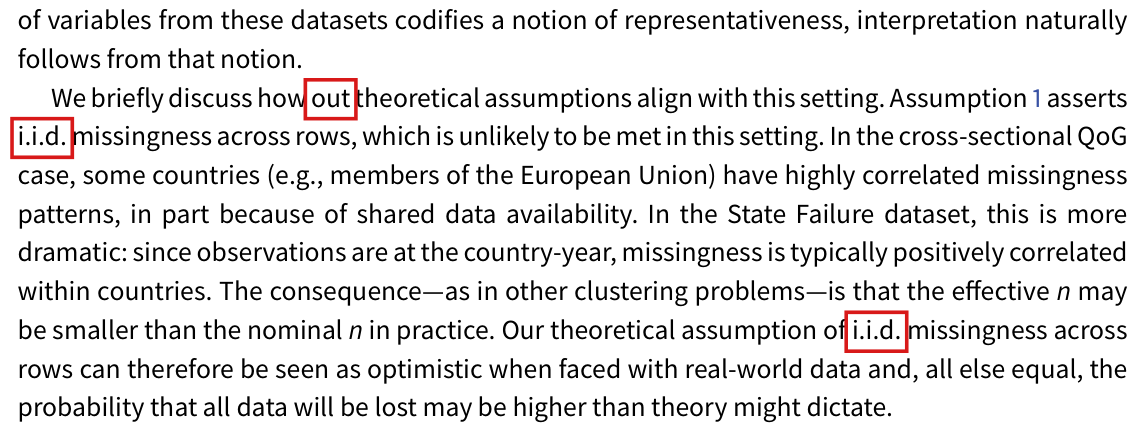
[Assumption 1, p. 150 (PDF p. 2)] “All rows of the data $((M_{11}, \ldots, M_{1k}), \ldots, (M_{n1}, \ldots, M_{nk}))$ are mutually independent.”
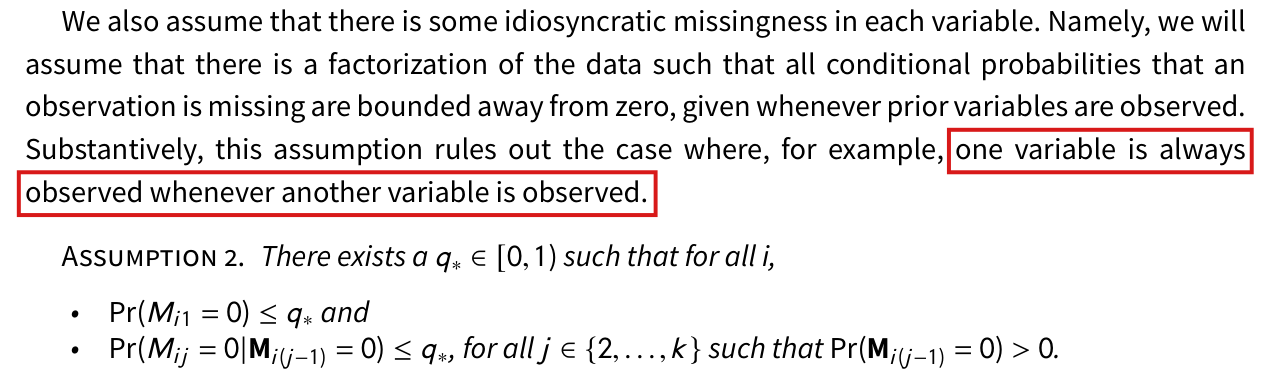
[Assumption 2, p. 150 (PDF p. 2)] “There exists a $q_* \in [0,1)$ such that for all $i$, • $\Pr(M_{i1} = 0) \leq q_*$ and • $\Pr(M_{ij} = 0|\mathbf{M}_{i(j-1)} = 0) \leq q_*$, for all $j \in \{2, \ldots, k\}$ such that $\Pr(\mathbf{M}_{i(j-1)} = 0) > 0$.”
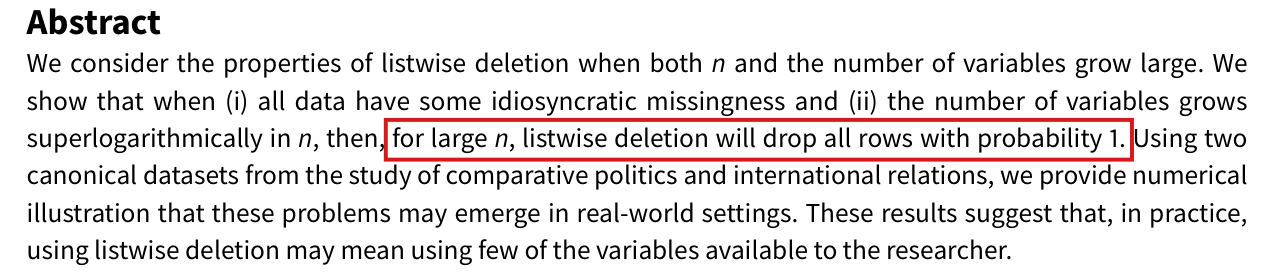
[The quantity $p_{all}$: Section 2.1, p. 150 (PDF p. 2)] “We begin by application of elementary probability theory to yield the following finite-$n$ result. In words, this result establishes an exact lower bound on the probability that all rows of the data will suffer from some missingness. In such instances, listwise deletion would yield no usable data.” Lemma 3 then names $p_{all}$ as “the probability that listwise deletion removes all rows”.
[The sequence: pp. 150-151 (PDF pp. 2-3)] “We can now consider the asymptotic properties of listwise deletion, letting both $k$ and $n$ tend to infinity. To do so, we embed the above problem into a sequence. We let $k_n = f(n)$, where $f$ has range over the natural numbers, and allow $M_{ij,n}$ and therefore $q_{ij,n}$ to vary at each $n$. To ease exposition, we omit notational dependence on $n$.”
[Assumption 4, p. 151 (PDF p. 3)] “The number of covariates grows superlogarithmically in $n$, so that $\lim_{n\to\infty} \frac{f(n)}{log(n)} = \infty$.” The next sentence: “Assumption 4 can be equivalently written in asymptotic shorthand notation as $k = \omega(\log n)$.”
[Reading fixed by the printed text and used in every target] $M_{ij} = 1$ means that entry $(i,j)$ is missing and $M_{ij} = 0$ that it is observed (the proof of Lemma 3, p. 154, treats $1 - \Pr(\mathbf{M}_{ik} = 0)$ as “the probability of a single observation containing at least one missing entry”). The event written $\mathbf{M}_{ij} = 0$ is $\{M_{i1} = \cdots = M_{ij} = 0\}$. Row $i$ is removed by listwise deletion when at least one of $M_{i1}, \ldots, M_{ik}$ equals 1, and $p_{all}$ is the probability that every one of the $n$ rows has at least one $j$ with $M_{ij} = 1$. $q_*$ is an upper bound on a probability of being observed. It is one constant, the same for every row and, along the sequence, for every $n$; the laws of the $M_{ij,n}$ may change with $n$ (this is the reading the validator fixed for P007-N002, which was not confirmed as an error). $n \geq 1$ and $k \geq 1$ are integers; $\log$ is the natural logarithm. The symbol $q_{ij}$ is defined only inside the proof of Lemma 3 (p. 154).
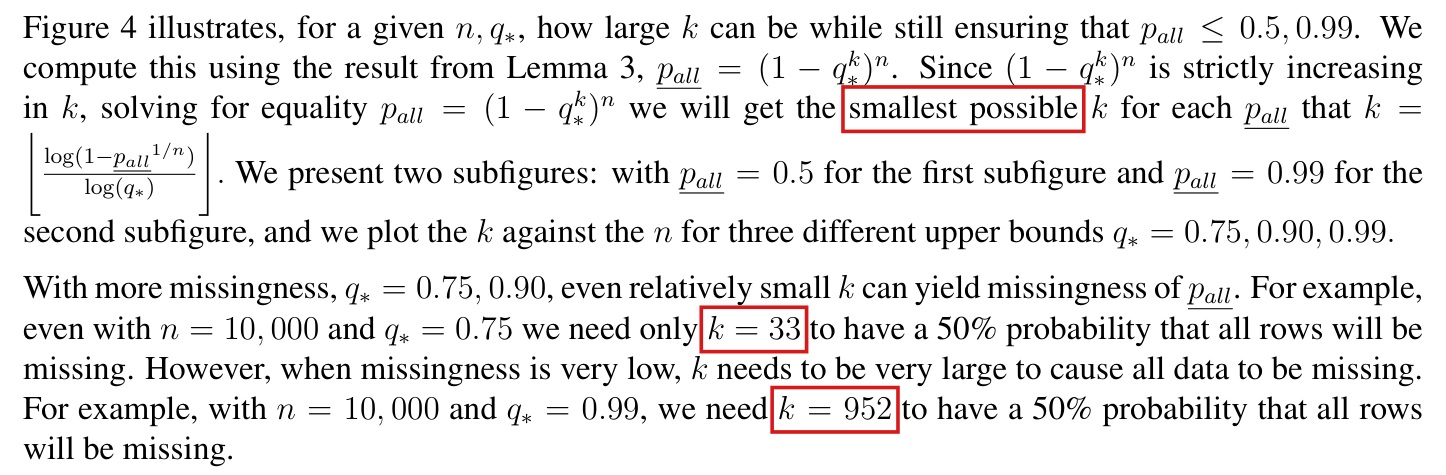
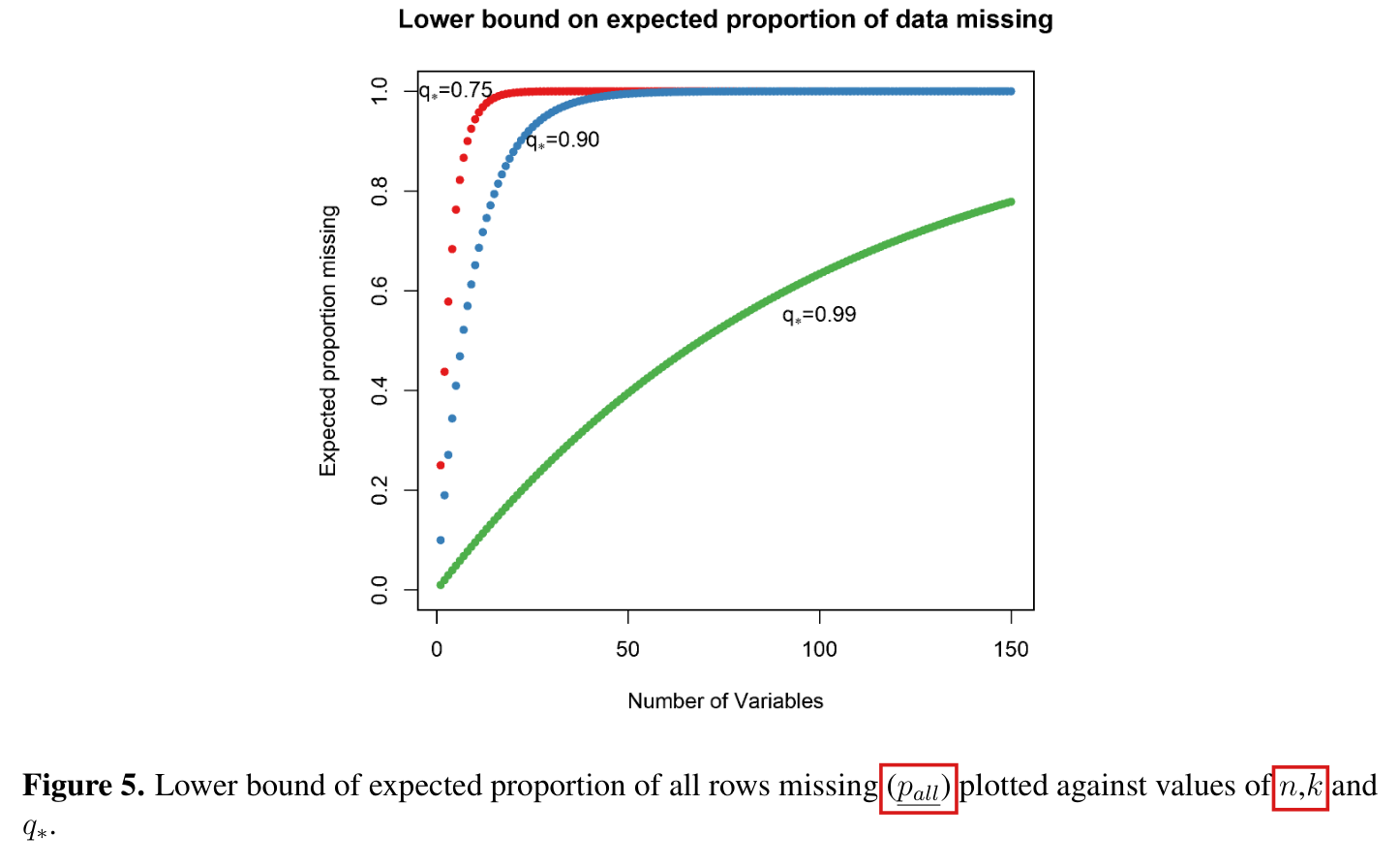
[Supplement, Supporting Information A, p. 1] “Here we demonstrate the finite-$n$ implications of our findings. In the following figures, we plot figures for different values of an upper bound on the conditional probability of each data entry being observed $q_*$, the number of observations (rows) $n$, the number of variables (columns) $k$ and a sharp lower bound on $p_{all}$ denoted $\underline{p_{all}} = (1 - q_*^{f(n)})^n$. $\underline{p_{all}}$ is the lowest possible (”best-case”) probability that listwise deletion removes all data.” And, same page: “By Lemma 3, we can compute $\underline{p_{all}} = (1 - q_*^k)^n$.”
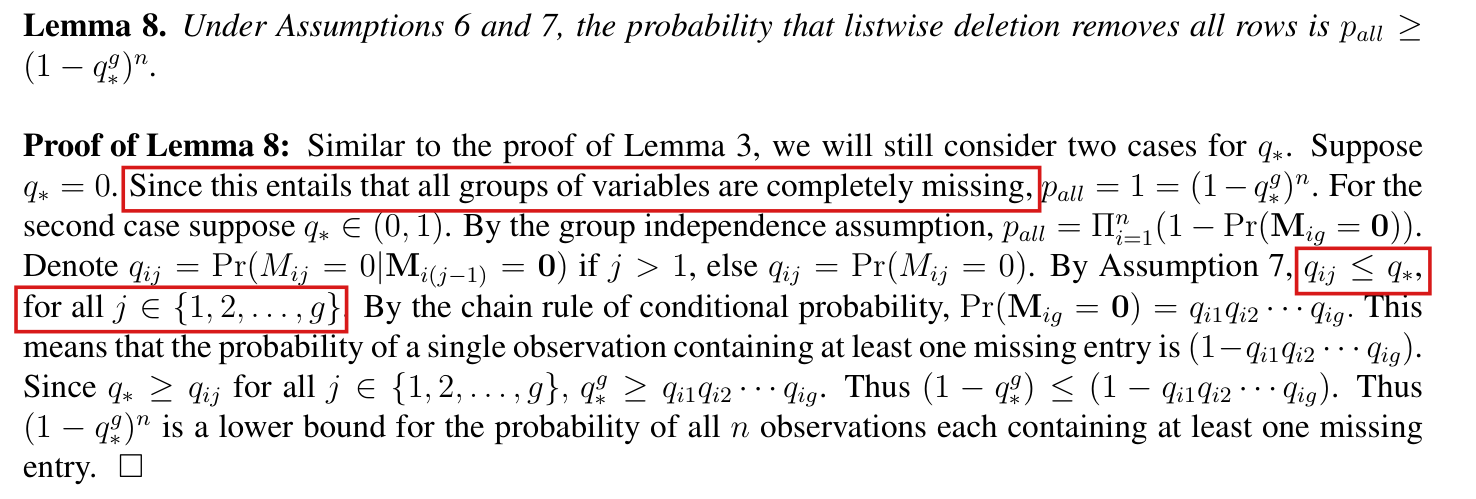
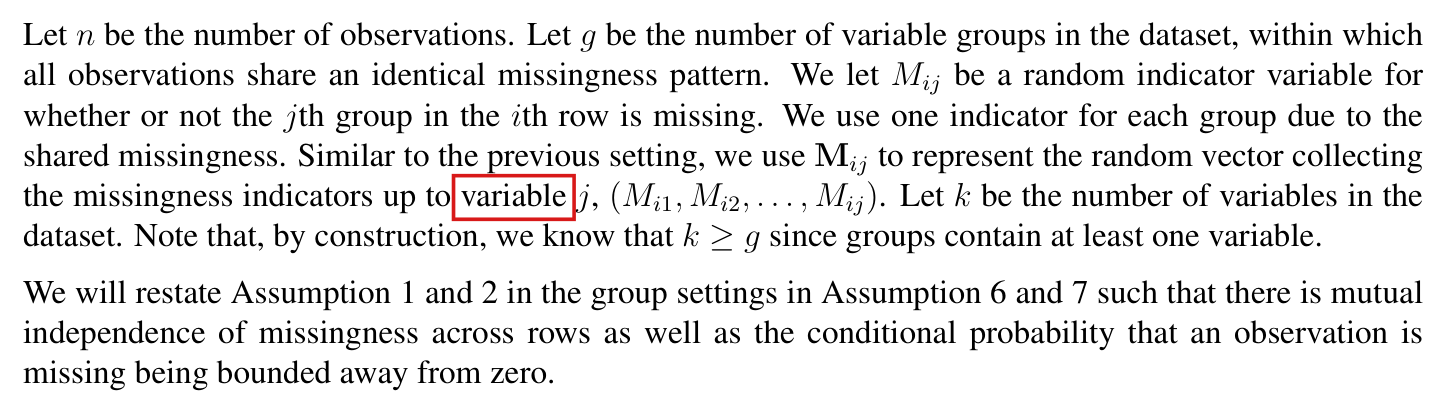
[Supplement, Supporting Information B, p. 3] “Let $n$ be the number of observations. Let $g$ be the number of variable groups in the dataset, within which all observations share an identical missingness pattern. We let $M_{ij}$ be a random indicator variable for whether or not the $j$th group in the $i$th row is missing. We use one indicator for each group due to the shared missingness. Similar to the previous setting, we use $\mathbf{M}_{ij}$ to represent the random vector collecting the missingness indicators up to variable $j$, $(M_{i1}, M_{i2}, \ldots, M_{ij})$. Let $k$ be the number of variables in the dataset. Note that, by construction, we know that $k \geq g$ since groups contain at least one variable.” [p. 4] Assumption 6: “All rows of the data $\left((M_{11}, ..., M_{1g}), ..., (M_{n1}, ..., M_{ng})\right)$ are mutually independent.” Assumption 7: “There exists a $q_* \in [0,1)$ such that for all $i$, • $\Pr(M_{i1} = 0) \leq q_*$ • $\Pr(M_{ij} = 0|\mathbf{M}_{i(j-1)} = \mathbf{0}) \leq q_*$, for all $j \in \{2, \ldots, g\}$ such that $\Pr(\mathbf{M}_{i(j-1)} = \mathbf{0}) > 0$”. The sequence: “Similarly, we will embed the problem into a sequence $g_n = l(n)$, where $l$ has range over the natural numbers, and allow $M_{ij,n}$ and $q_{ij,n}$ to vary at each $n$. We omit the $n$ notation for simplicity.” Assumption 9: “The number of groups of covariates grows superlogarithmically in $n$, so that $\lim_{n\to\infty} \frac{l(n)}{log(n)} = \infty$.”
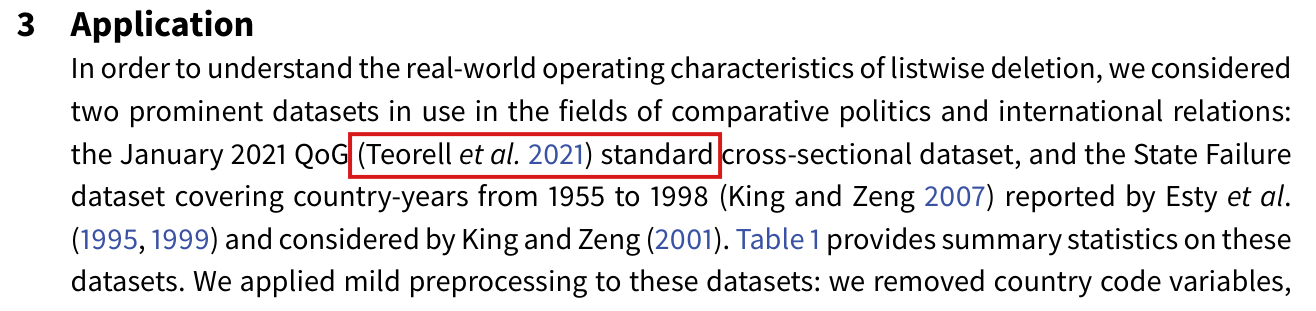
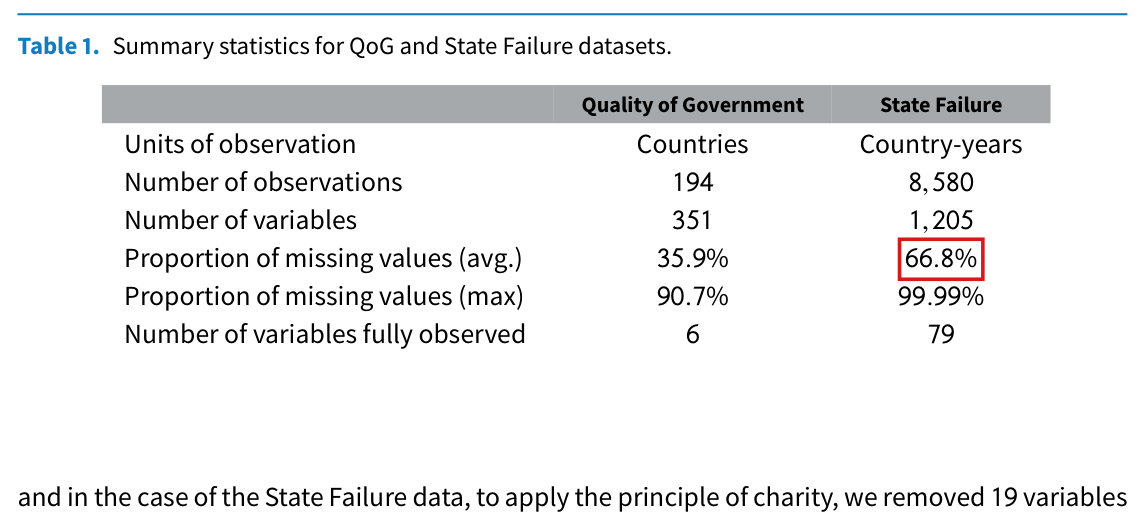
[Application: Section 3, pp. 151-152 (PDF pp. 3-4)] “We applied mild preprocessing to these datasets: we removed country code variables, and in the case of the State Failure data, to apply the principle of charity, we removed 19 variables that exhibited 100% missingness.” [Section 3.1, p. 152 (PDF p. 4)] “To do so, we conducted 25,000 simulations in each of which we drew $k$ of the variables from each dataset (without replacement). We then recorded the number of rows of the data that survive listwise deletion. We then report the expected proportion of remaining data observed after listwise deletion, as well as the probability that all rows of the data exhibit some missingness. Note that, here, expected values and probabilities refer to the randomness induced by our random subsampling procedure, not any fundamental stochasticity giving rise to the underlying data.” So in the application the data are a fixed array of missing and observed cells, and the only randomness is the uniform draw of $k$ of its variables without replacement. Assumptions 1 and 2 play no part in the targets about the application (P007-T1, P007-T2, P007-T12, P007-T13).
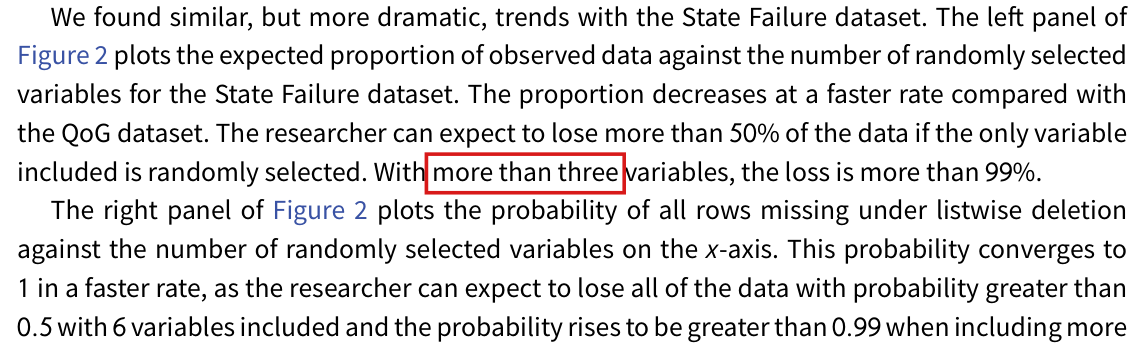
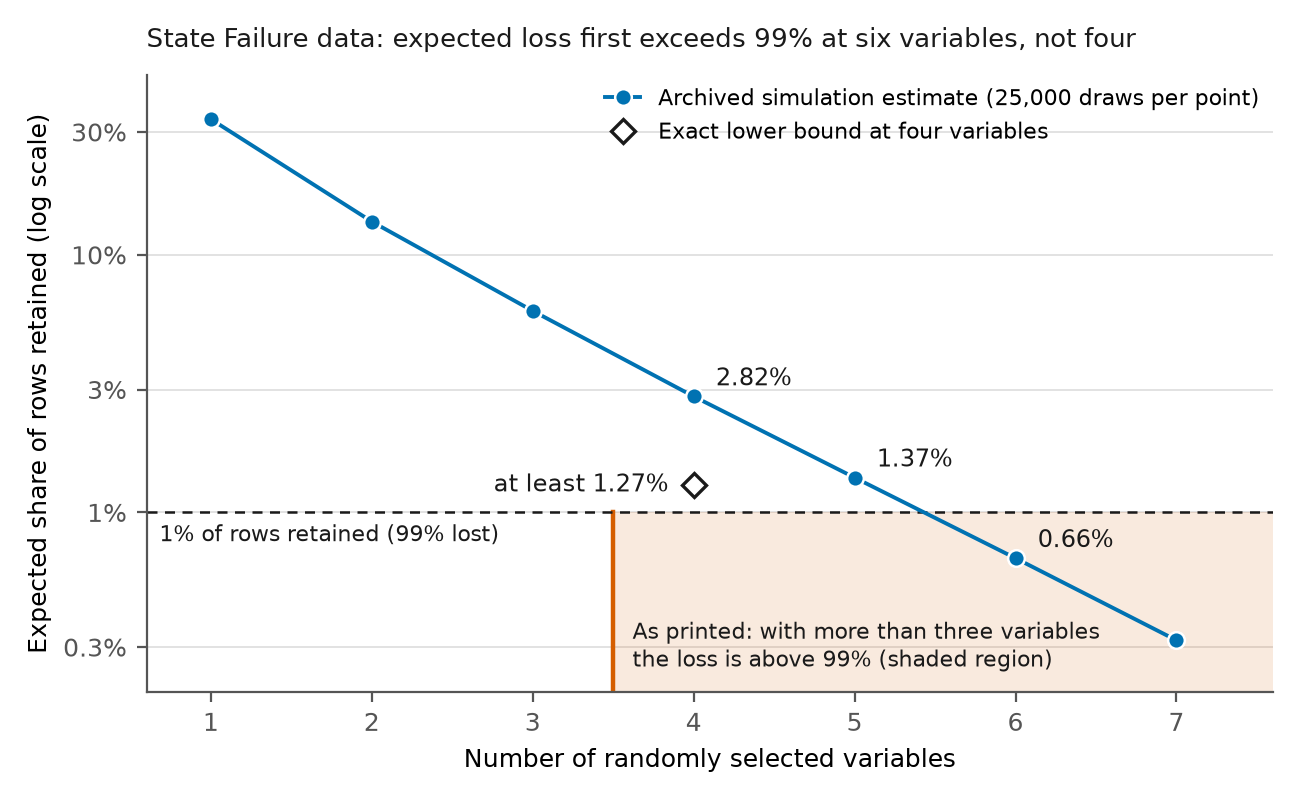
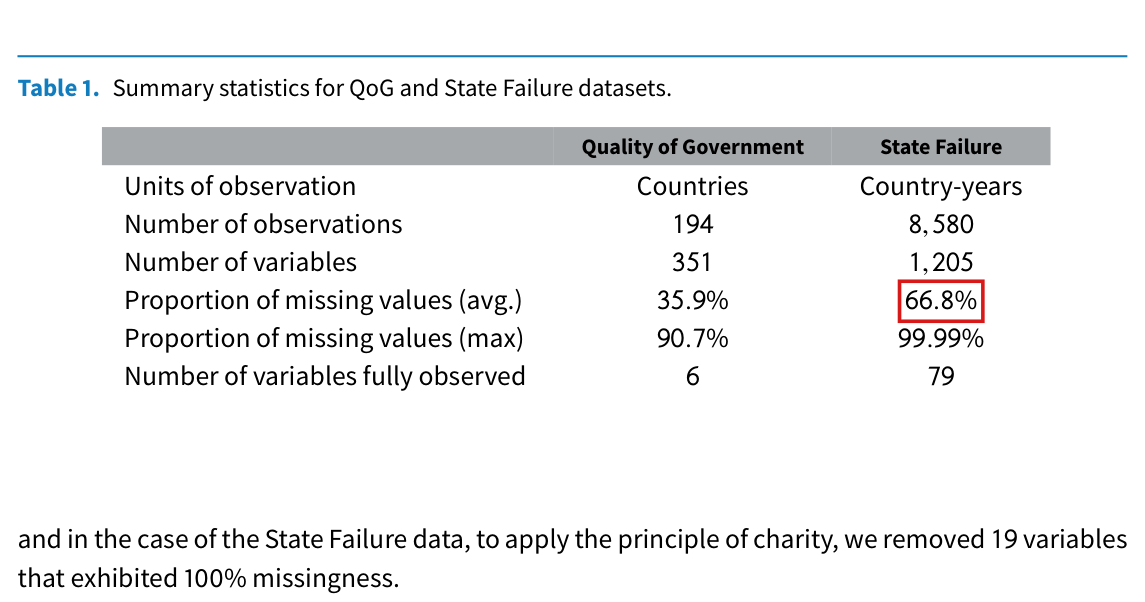
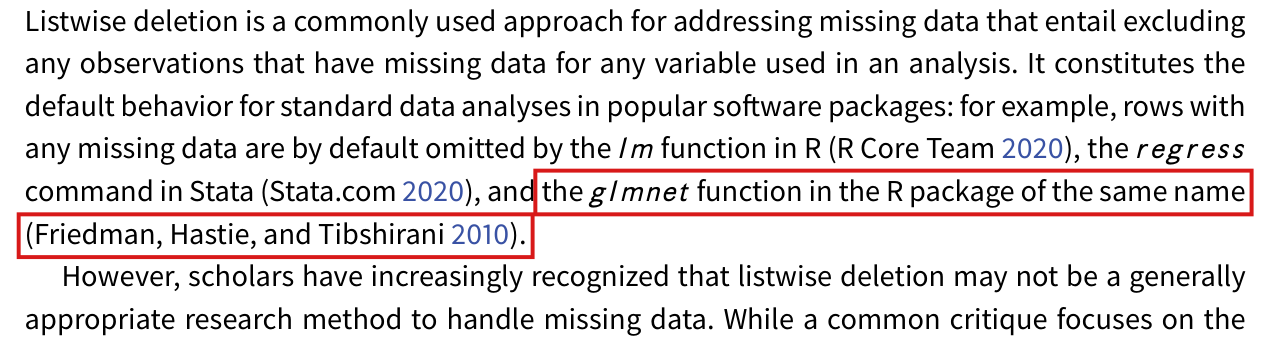
Scope of the targets. Headline claims that are mathematical statements: P007-H1 (Lemma 3: P007-T14), P007-H2 (Proposition 5: P007-T16) and P007-H6 (Lemma 8 and Proposition 10: P007-T15 and P007-T17). P007-H3 (the finite-$n$ illustration of the bound), P007-H4 and P007-H5 (the two data illustrations) and P007-H7 (the conclusion) are numerical illustrations, simulation results or interpretive remarks, so they are not headline targets; the formal content of the findings that touch P007-H3 and P007-H5 is in the targets below. Confirmed errors with mathematical content, each with a corrected-statement target: P007-E010 (Moderate; Table 1's State Failure average and the threshold “more than three variables”: exact refutation P007-T1, correction P007-T2, statement as printed P007-T13); P007-E003 (Minor; the printed proofs of Lemmas 3 and 8 and of Propositions 5 and 10: P007-T3 to P007-T6); P007-E005 (Minor; the Figure 4 paragraph of the supplement: P007-T7, P007-T8); P007-E006 (Minor; “upper bound” and the caption of Figure 5: P007-T9, P007-T10); P007-E004 (Minor; “i.i.d.” for Assumption 1: P007-T11); P007-E014 (Minor; its established part is the same stale Table 1 average: P007-T12). Confirmed errors that are not targets, because their corrections change no mathematical statement: P007-E009 (Moderate; the analysed file is the QoG Basic dataset and not the Standard dataset that is cited, a matter of data provenance, and every QoG number stands for the deposited file); P007-E001 (the glmnet software example); P007-E013 (a garbled reference entry); within P007-E004, the misprint “out” for “our”; within P007-E014, the behaviour of the is.na mask on empty Stata strings (a property of the code whose effect on the State Failure data was not established). Not targets because they are not rated as errors: P007-E002 and P007-N001 (clarity notes), P007-N002, P007-N004, P007-N005 and P007-N006 (not confirmed), P007-N003 (undetermined), P007-N007 (out of scope).
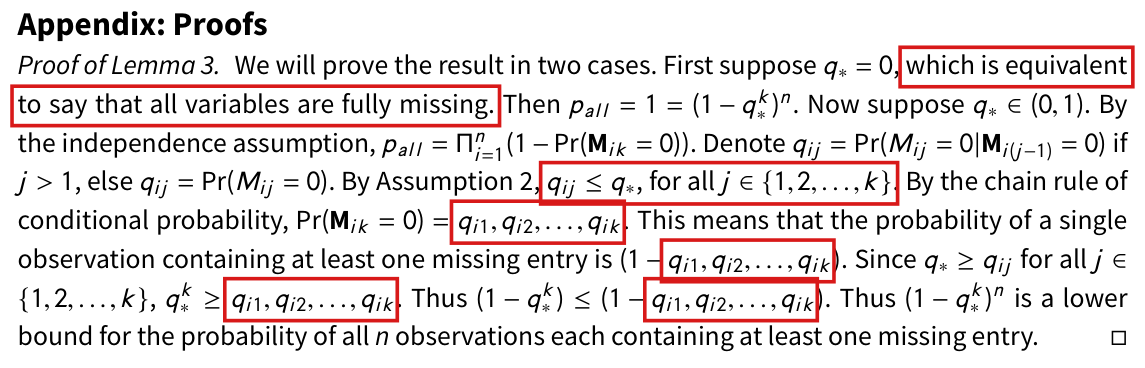
Effective claim (source TeX): [Printed proof of Lemma 3, p. 154 (PDF p. 6), in full] “We will prove the result in two cases. First suppose $q_* = 0$, which is equivalent to say that all variables are fully missing. Then $p_{all} = 1 = (1 - q_*^k)^n$. Now suppose $q_* \in (0,1)$. By the independence assumption, $p_{all} = \Pi_{i=1}^{n}(1 - \Pr(\mathbf{M}_{ik} = 0))$. Denote $q_{ij} = \Pr(M_{ij} = 0|\mathbf{M}_{i(j-1)} = 0)$ if $j > 1$, else $q_{ij} = \Pr(M_{ij} = 0)$. By Assumption 2, $q_{ij} \leq q_*$, for all $j \in \{1,2,\ldots,k\}$. By the chain rule of conditional probability, $\Pr(\mathbf{M}_{ik} = 0) = q_{i1}, q_{i2}, \ldots, q_{ik}$. This means that the probability of a single observation containing at least one missing entry is $(1 - q_{i1}, q_{i2}, \ldots, q_{ik})$. Since $q_* \geq q_{ij}$ for all $j \in \{1,2,\ldots,k\}$, $q_*^k \geq q_{i1}, q_{i2}, \ldots, q_{ik}$. Thus $(1 - q_*^k) \leq (1 - q_{i1}, q_{i2}, \ldots, q_{ik})$. Thus $(1 - q_*^k)^n$ is a lower bound for the probability of all $n$ observations each containing at least one missing entry.” The proof of Lemma 8 (Supplement p. 4) is the same with $g$ for $k$, Assumption 7 for Assumption 2, “the group independence assumption” for “the independence assumption”, and the products printed as $q_{i1}q_{i2} \cdots q_{ig}$.
[Sol's corrected text (validated.json, P007-E003, prior_correction.corrected_text), verbatim] “Main page 154 and supplement pages 3-5: If q_*=0, the first variable/group is missing almost surely in every row, hence p_all=1. Let C_ij be the event that row i survives its first j variables/groups, with C_i0 the sure event. If P(C_i,j-1)=0 then P(C_ij)=0; otherwise Assumption 2/7 gives P(C_ij)<=q_* P(C_i,j-1). Thus P(C_ih)<=q_*^h and row independence gives p_all>=(1-q_*^h)^n, with h=k or g. Bernoulli gives 1-nq_*^h<=(1-q_*^h)^n<=1. For fixed 0<q_*<1 and h/log n tending to infinity, nq_*^h tends to zero; for q_*=0 the endpoint is immediate. Therefore p_all tends to 1. Replace the comma lists with products, remove stars on >=, balance superscript parentheses, write g=l(n) on supplement page 4, and up to group j on supplement page 3. Row independence (Assumption 6) may replace the group independence label for clarity.” The sentences from “Bernoulli gives” to “Therefore p_all tends to 1” concern the propositions and are P007-T6.
[Mathematical content of the repaired lemma proofs, with every hypothesis]
[Setting] Integers $n \geq 1$ and $h \geq 1$, where $h = k$ (the number of variables) for Lemma 3 and $h = g$ (the number of groups) for Lemma 8. A probability space carrying indicators $M_{ij} \in \{0,1\}$ for $i = 1, \ldots, n$ and $j = 1, \ldots, h$, with $M_{ij} = 1$ when variable (group) $j$ of row $i$ is missing and $M_{ij} = 0$ when it is observed. For $j = 0, 1, \ldots, h$ let $C_{ij} = \{M_{i1} = \cdots = M_{ij} = 0\}$, with $C_{i0}$ the sure event, and $s_{ij} = \Pr(C_{ij})$; $C_{ij}$ is the printed event $\mathbf{M}_{ij} = 0$, where in the supplement $\mathbf{M}_{ij}$ collects the indicators up to group $j$ (printed: “up to variable $j$”). $p_{all} = \Pr\left(\bigcap_{i=1}^{n} C_{ih}^{c}\right)$.
[Hypotheses] (A2: Assumption 2, respectively 7) $q_*$ is a real number in $[0,1)$ such that, for every row $i$: $s_{i1} \leq q_*$, and for every $j \in \{2, \ldots, h\}$ with $s_{i(j-1)} > 0$, $s_{ij}/s_{i(j-1)} \leq q_*$ (the ratio is $\Pr(M_{ij} = 0 \mid \mathbf{M}_{i(j-1)} = 0)$). (A1: Assumption 1, respectively 6) the $n$ row vectors $(M_{i1}, \ldots, M_{ih})$, $i = 1, \ldots, n$, are mutually independent.
[Statement]
(a) [Replaces “$q_* = 0$, which is equivalent to say that all variables are fully missing”.] Under (A2), if $q_* = 0$ then $\Pr(M_{i1} = 1) = 1$ for every row $i$; hence every row has a missing entry with probability one and $p_{all} = 1 = (1 - q_*^h)^n$. Nothing follows about $M_{ij}$ for $j \geq 2$ (P007-T3). Row independence is not used.
(b) [Replaces “By Assumption 2, $q_{ij} \leq q_*$, for all $j$”.] Under (A2), for every row $i$ and every $j \in \{1, \ldots, h\}$: $s_{ij} \leq q_*\, s_{i(j-1)}$. The three cases are: $j = 1$, where $s_{i0} = 1$; $j \geq 2$ with $s_{i(j-1)} = 0$, where $C_{ij} \subseteq C_{i(j-1)}$ gives $s_{ij} = 0$; and $j \geq 2$ with $s_{i(j-1)} > 0$, where (A2) applies.
(c) [Replaces the chain-rule sentence and the comma lists.] Define $q_{i1} = s_{i1}$ and, for $j \geq 2$, $q_{ij} = s_{ij}/s_{i(j-1)}$ if $s_{i(j-1)} > 0$ and $q_{ij} = 0$ if $s_{i(j-1)} = 0$. Then $\Pr(\mathbf{M}_{ih} = 0) = s_{ih} = q_{i1} q_{i2} \cdots q_{ih}$, a product (the printed “$q_{i1}, q_{i2}, \ldots, q_{ik}$” denotes this product); and under (A2), $0 \leq q_{ij} \leq q_*$ for all $j \in \{1, \ldots, h\}$.
(d) Under (A2), $s_{ih} \leq q_*^h$ for every row $i$; equivalently $(1 - q_*^h) \leq (1 - q_{i1} q_{i2} \cdots q_{ih})$: each row contains at least one missing entry with probability at least $1 - q_*^h$.
(e) Under (A1) and (A2), $p_{all} = \prod_{i=1}^{n}(1 - s_{ih}) \geq (1 - q_*^h)^n$, for every $q_* \in [0,1)$ and with no separate case for $q_* = 0$.
: SAP.P007.T5Statement
Theorem: SAP.P007.T5
Statement hash: 67c0e5debea5505e8fa598d3b68c39136d5860847385c991faedfe349b2126b8
Statement definition: SAP.P007.T5Statement
Certificate. 20261104T174148Z
Declaration review: faithful; 2026-11-04T18:15:33Z; binding v2
Evidence scope: Certification checks formal proof objects. Statement fidelity is a model judgment. Author review is separate.
Proof dependencies: Independently extracted
Source and evidence metadata · sap-2026-11-08-assured-release