LLM-generated corrections to the published research of P. M. Aronow

Commentary/article P053

Corrections to: Understanding Ding's Apparent Paradox

P. M. Aronow and Molly R. Offer-Westort (2017). Understanding Ding's Apparent Paradox. Statistical Science 32(3):346–348.

DOI
10.1214/16-STS582
Audited edition
Statistical Science, 2017, 32(3):346–348; 3 pages in the audited file
SHA-256 of the audited file
15c35664f0b88617333122565ee62b23f8611e25af1fcdb06b9923f9c678be2f
Permanent address
https://pmaronow.github.io/llm-audit/works/P053/

Summary

This three-page comment explains the apparent paradox of Ding (2017), in which Neyman’s null of no average effect can be rejected while Fisher’s sharp null is not. It combines two known results: the Fisher randomization test is asymptotically a Rao score test, whose reference variance exceeds that of its Wald-type analogue by τ2/N\tau^2/N to first order, and a test that assumes equal variances behaves as in the Behrens–Fisher problem. No entries are classified as errors, and 2 are clarity notes. One possible error about a cited source was not confirmed, and one remains undetermined.

What was and was not checked

The comment is three pages, with no table, figure, numerical example or appendix, and I read all of it. The following algebra and asymptotic comparisons held up under the comment’s regularity conditions and, for the tests, a positive limiting variance.

  • p. 347: the expansions V^(Neyman)=S12/N1+S02/N0+op(N−1)\widehat{V}(\text{Neyman}) = S_1^2/N_1 + S_0^2/N_0 + o_p(N^{-1}), V^(Fisher)=S12/N0+S02/N1+τ2/N+op(N−1)\widehat{V}(\text{Fisher}) = S_1^2/N_0 + S_0^2/N_1 + \tau^2/N + o_p(N^{-1}) and V^(OLS)=S12/N0+S02/N1+op(N−1)\widehat{V}(\text{OLS}) = S_1^2/N_0 + S_0^2/N_1 + o_p(N^{-1}), and the difference V^(Fisher)−V^(OLS)=τ2/N+op(N−1)\widehat{V}(\text{Fisher}) - \widehat{V}(\text{OLS}) = \tau^2/N + o_p(N^{-1}), which is op(N−1)o_p(N^{-1}) when τN=o(1)\tau_N = o(1).
  • p. 347: the Wald-type test with V^(OLS)\widehat{V}(\text{OLS}) is asymptotically valid under the sharp null hypothesis and under constant effects. Under constant nonlocal effects, V^(OLS)\widehat{V}(\text{OLS}) is consistent for V(τ^)V(\widehat\tau), and V^(Fisher)\widehat{V}(\text{Fisher}) overstates it by τ2/N\tau^2/N to first order.
  • p. 347: the display for V^(OLS)−V^(Neyman)\widehat{V}(\text{OLS}) - \widehat{V}(\text{Neyman}). Its limit after multiplication by NN is (S12−S02)(2p−1)/(p(1−p))(S_1^2 - S_0^2)(2p-1)/(p(1-p)), so S1≠S0S_1 \ne S_0 is necessary for a difference, as the comment states.
  • p. 347: lim⁡N→∞NV(τ^)≤S12/p+S02/(1−p)\lim_{N\to\infty} N V(\widehat\tau) \le S_1^2/p + S_0^2/(1-p), with equality under constant effects. The exact randomization variance S12/N1+S02/N0−Sτ2/NS_1^2/N_1 + S_0^2/N_0 - S_\tau^2/N agreed with complete enumeration of small populations.
  • p. 348: there exist limit distributions such that lim⁡N→∞NV(τ^)>S02/p+S12/(1−p)\lim_{N\to\infty} N V(\widehat\tau) > S_0^2/p + S_1^2/(1-p). With p=1/5p = 1/5, S12=4S_1^2 = 4, S02=1S_0^2 = 1 and Sτ2=1S_\tau^2 = 1, the limits after multiplication by NN are 81/481/4 for the true variance, 1010 for V^(OLS)\widehat{V}(\text{OLS}) and 85/485/4 for V^(Neyman)\widehat{V}(\text{Neyman}). At nominal size 0.050.05, the test with V^(OLS)\widehat{V}(\text{OLS}) then has asymptotic size about 0.1680.168.
  • p. 348: the test with V^(OLS)\widehat{V}(\text{OLS}) may be more or less powerful than the test with V^(Neyman)\widehat{V}(\text{Neyman}). There exist exact examples in which the limit for V^(OLS)\widehat{V}(\text{OLS}) is no smaller than the true variance and is below the limit for V^(Neyman)\widehat{V}(\text{Neyman}), and examples in which it is above that limit. The inequality S12/p+S02/(1−p)<S02/p+S12/(1−p)S_1^2/p + S_0^2/(1-p) < S_0^2/p + S_1^2/(1-p) is equivalent to the bracketed condition, (p>1/2p > 1/2 and S1>S0S_1 > S_0) or (p<1/2p < 1/2 and S1<S0S_1 < S_0).
  • Sections 2 and 3 together: V^(Fisher)−V^(Neyman)=τ2/N+(1/N0−1/N1)(S12−S02)+op(N−1)\widehat{V}(\text{Fisher}) - \widehat{V}(\text{Neyman}) = \tau^2/N + (1/N_0 - 1/N_1)(S_1^2 - S_0^2) + o_p(N^{-1}), so the two parts of the explanation account for the whole difference to first order.
  • p. 348, Section 4: the signed-versus-absolute-value comparison. The statistic ∣τ^∣|\widehat\tau| is not strictly increasing in τ^\widehat\tau, and exact examples show that the two statistics can have different upper-tail p-values in the randomization test. The replacement claim holds for statistics based on the two-by-two treatment-by-outcome table; see P053-E001.
  • The citation of Engle (1984) for the possible suboptimality of Rao-type tests, and the quotation from p. 786, agree with the chapter.
  • The cross-references within the comment point to the right places. The pages cited for Engle (786) and for Reichardt and Gollob (124–125) lie within the page ranges in the reference list.

These checks concern the comparison of asymptotic normal approximations. They do not establish a uniform approximation of the exponentially small tails of the randomization test under fixed alternatives.

The following were not checked. Of Ding (2017), only the preprint was read, and only for Theorem 7, its proof and the definition of the test. The published article, its equation (7), its Section A.3.1 and Ding’s rejoinder were not read, and neither was Copas (1973). Whether the published Theorem 7 is in error as the comment says, and whether Copas’s equation (9) states the claim attributed to it, were not settled. The other cited works were not compared with their sources: Reichardt and Gollob (1999), Lin (2013), Samii and Aronow (2012), Freedman (2008), Pratt (1964), Romano (1990), Neyman (1990), Aronow (2013), Mosteller and Rourke (1973), and Gerber and Green (2012).

The comment has no simulation and no empirical application, and I found no supplement, erratum or replication files for it, so there were no published numerical results to reproduce from code. The absence of further corrections is not a finding that the comment is correct.

Headline claims and related corrections

  1. The FRT with the difference in means is asymptotically a Rao-type score test under constant effects, and its reference variance exceeds that of the pooled Wald-type analogue V^(OLS)\widehat V(\mathrm{OLS}) by τ2/N\tau^2/N to first order. It can therefore be less powerful under nonlocal constant-effect alternatives.

    Section 2, p. 347: the displays for V^(Fisher)\widehat V(\mathrm{Fisher}), V^(OLS)\widehat V(\mathrm{OLS}) and V^(Fisher)−V^(OLS)=τ2/N+op(N−1)\widehat V(\mathrm{Fisher})-\widehat V(\mathrm{OLS})=\tau^2/N+o_p(N^{-1}); Introduction, item (i), p. 346

  2. A Wald-type analogue of the FRT, using homoskedastic OLS or the pooled-variance two-sample zz-test, is asymptotically valid under Fisher's sharp null and asymptotically equivalent to the difference-in-means FRT under local alternatives τN=o(1)\tau_N=o(1).

    Section 2, p. 347: the display for V^(OLS)\widehat V(\mathrm{OLS}) and the paragraph beginning “Under Pitman-type local alternatives,” with V^(Fisher)−V^(OLS)=op(N−1)\widehat V(\mathrm{Fisher})-\widehat V(\mathrm{OLS})=o_p(N^{-1}); Introduction, item (i), p. 346

  3. The Wald-type variance estimates V^(OLS)\widehat V(\mathrm{OLS}) and V^(Neyman)\widehat V(\mathrm{Neyman}) differ asymptotically only if S1≠S0S_1\ne S_0. Neyman's estimate is conservative for V(τ^)V(\hat\tau) and asymptotically exact under constant effects; under heterogeneous effects the pooled OLS test can be invalid for Neyman's null. The OLS-based test can be more or less powerful, and the stated direction of the paradox occurs when (p>1/2 and S1>S0)(p>1/2\text{ and }S_1>S_0) or (p<1/2 and S1<S0)(p<1/2\text{ and }S_1<S_0).

    Section 3, pp. 347–348: the display for V^(OLS)−V^(Neyman)\widehat V(\mathrm{OLS})-\widehat V(\mathrm{Neyman}), Neyman’s upper bound, and the inequality S12/p+S02/(1−p)<S02/p+S12/(1−p)S_1^2/p+S_0^2/(1-p)<S_0^2/p+S_1^2/(1-p) with its bracketed equivalent; Introduction, item (ii), p. 346

  4. The comment explains Ding’s apparent paradox by combining the first-order reference-variance inflation of τ2/N\tau^2/N for the Rao-type test under nonlocal alternatives with the Behrens–Fisher-type behavior of tests that assume S1=S0S_1=S_0 when that equality fails.

    Introduction, “Combining (i) and (ii),” p. 346; Sections 2 and 3 together; Conclusion, p. 348

  5. The comment argues that Ding's Theorem 7, concerning equivalence of test statistics for binary outcomes, is too general. It proposes a weaker claim: in a completely randomized experiment with binary outcomes, under the sharp null every test statistic can be written as a function of the difference in means.

    Section 4, 'A Note on Theorem 7' (p. 348), especially the replacement claim attributed to Copas (1973), equation (9); Introduction item (iii) (p. 346)

    See P053-E001.

Corrections

No corrections are listed for this work.

Clarity notes

Imprecise or ambiguous wording whose intended meaning is correct; not an error.

In the replacement for Ding’s Theorem 7, “all test statistics” should read “all test statistics based on the two-by-two treatment-by-outcome table”, which is the class that the claim concerns and for which it is correct.

Section 4, p. 348 (PDF p. 3), the sentence beginning “Here, we state a weaker claim”, from the foot of the left column to the top of the right column; Introduction, item (iii), p. 346 (PDF p. 1)

See also under Formal statements (Lean): P053-T1, P053-T2

As printed

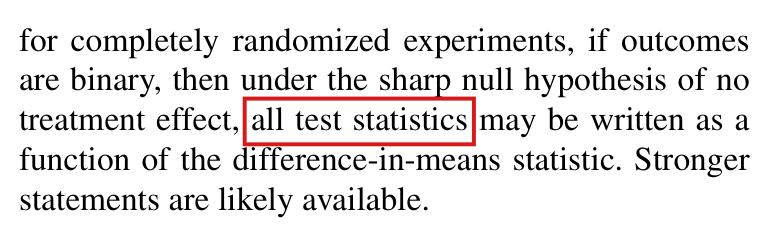
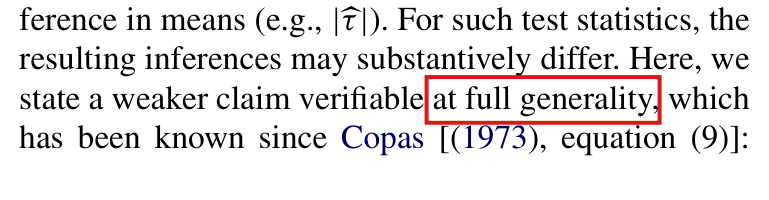
Section 4, p. 348: Here, we state a weaker claim verifiable at full generality, which has been known since Copas [(1973), equation (9)]: for completely randomized experiments, if outcomes are binary, then under the sharp null hypothesis of no treatment effect, all test statistics may be written as a function of the difference-in-means statistic. Stronger statements are likely available.

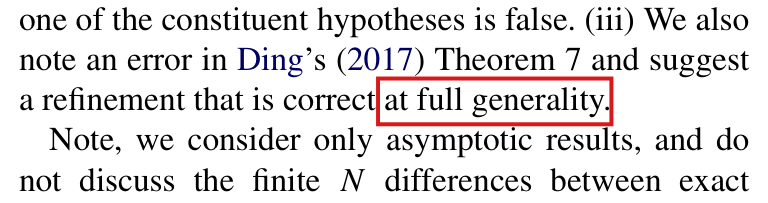
Introduction, item (iii), p. 346: We also note an error in Ding’s (2017) Theorem 7 and suggest a refinement that is correct at full generality.

Intended meaning

The sentence takes the words “all test statistics” from Ding’s Theorem 7, which the comment quotes a few lines above, and it replaces “are equivalent to” by “may be written as a function of”. In the preprint of Ding’s article (arXiv:1402.0142v4, Supplementary Material, p. 38), the proof of Theorem 7 begins “All test statistics are functions of the two by two table”. The preprint was not compared with the published article and its supplement. Read with that proof, “all test statistics” ranges over the statistics based on the two-by-two treatment-by-outcome table, and “at full generality” covers all of them, including those that are not monotone in the difference in means τ^\widehat\tau. The comment’s own example, ∣τ^∣|\widehat\tau|, is such a statistic. The article of Copas that the sentence cites is titled “Randomization models for the matched and unmatched 2×22 \times 2 tables”; its equation (9) was not read. With this reading the claim is correct.

To see this, let N1N_1 and N0N_0 be the fixed positive numbers of treated and control units, and let N=N1+N0N = N_1 + N_0. Under the sharp null hypothesis, unit ii has one binary outcome yi=Yi(1)=Yi(0)y_i = Y_i(1) = Y_i(0), and the number of successes K=∑iyiK = \sum_i y_i is the same for every assignment. If aa of the treated units are successes, then the table has cells aa, N1−aN_1 - a, K−aK - a and N0−K+aN_0 - K + a, and

τ^=aN1−K−aN0=Na−N1KN1N0.\widehat\tau = \frac{a}{N_1} - \frac{K - a}{N_0} = \frac{N a - N_1 K}{N_1 N_0}.

Solving for aa, I obtain

a=N1N0τ^+N1KN1+N0.a = \frac{N_1 N_0 \widehat\tau + N_1 K}{N_1 + N_0}.

Then τ^\widehat\tau determines aa, and aa determines the four cells. This implies that every statistic based on the table is a function of τ^\widehat\tau, whether or not it is monotone in τ^\widehat\tau. A statistic that depends on the treated outcomes and on the control outcomes, and not on their order within either sample, is based on the table, since a binary sample is determined up to order by its number of successes.

The sentence does not name this class. If “all test statistics” is taken to include statistics that use the labels of the units or fixed covariates, then the claim is false. For example, suppose that there are N=4N = 4 units with N1=N0=2N_1 = N_0 = 2, that the outcomes are y=(1,1,0,0)y = (1,1,0,0) under both treatments, and that X=(0,1,2,3)X = (0,1,2,3) is a fixed covariate. Let ZZ be the vector of treatment indicators, and let β^\widehat\beta be the coefficient on ZZ in the least-squares regression of the outcome on a constant, ZZ and XX. The six assignments are equally likely.

The six assignments in the example with four units. The cells of the two-by-two table are listed as (treated successes, treated failures, control successes, control failures).
Assignment ZZCellsτ^\widehat\tauβ^\widehat\betaZ1y1Z_1 y_1
(1,1,0,0)(1,1,0,0)(2,0,0,2)(2,0,0,2)111111
(1,0,1,0)(1,0,1,0)(1,1,1,1)(1,1,1,1)00−1/2-1/211
(1,0,0,1)(1,0,0,1)(1,1,1,1)(1,1,1,1)000011
(0,1,1,0)(0,1,1,0)(1,1,1,1)(1,1,1,1)000000
(0,1,0,1)(0,1,0,1)(1,1,1,1)(1,1,1,1)001/21/200
(0,0,1,1)(0,0,1,1)(0,2,2,0)(0,2,2,0)−1-1−1-100

The assignments (1,0,1,0)(1,0,1,0) and (0,1,0,1)(0,1,0,1) have the same cells and τ^=0\widehat\tau = 0, but β^\widehat\beta is −1/2-1/2 at the first and 1/21/2 at the second. The statistic Z1y1Z_1 y_1, which uses no covariate, is 11 at the first and 00 at the second. Neither statistic is a function of τ^\widehat\tau. Repeating the four units mm times gives the same values at every N=4mN = 4m, so the asymptotic conditions on p. 347 do not change this.

Nothing else in the comment uses the sentence. The distinction between functional dependence and identical inference, the variance comparisons of Sections 2 and 3, and the conclusion are unaffected. In the example, the assignment with τ^=1\widehat\tau = 1 has upper-tail p-value 1/61/6 for τ^\widehat\tau and 1/31/3 for ∣τ^∣|\widehat\tau| in the randomization test. This is the comment’s own point: a function of τ^\widehat\tau need not give the same inference as τ^\widehat\tau.

Corrected

Section 4, p. 348: … for completely randomized experiments, if outcomes are binary, then under the sharp null hypothesis of no treatment effect, all test statistics based on the two-by-two treatment-by-outcome table may be written as a function of the difference-in-means statistic.

Introduction, item (iii), p. 346: … a refinement that is correct at full generality for statistics based on the two-by-two treatment-by-outcome table.

The statement in full: in a completely randomized experiment with fixed positive treatment and control counts N1N_1 and N0N_0 and binary outcomes, under the sharp null hypothesis of no treatment effect, every test statistic that depends on the data only through the two-by-two treatment-by-outcome table is a function of the difference-in-means statistic τ^\widehat\tau. With KK total successes and aa treated successes,

a=N1N0τ^+N1KN1+N0,a = \frac{N_1 N_0 \widehat\tau + N_1 K}{N_1 + N_0},

which determines all four cells of the table.

Crop of five lines at the top of the right column of page 348. They read: for completely randomized experiments, if outcomes are binary, then under the sharp null hypothesis of no treatment effect, all test statistics may be written as a function of the difference-in-means statistic. Stronger statements are likely available. A red outline surrounds the words all test statistics.
Section 4, p. 348 (PDF p. 3), top of the right column: the claim, which ends the sentence. The outline marks “all test statistics”.
Crop of four lines at the foot of the left column of page 348. They read: ference in means (e.g., the absolute value of tau-hat). For such test statistics, the resulting inferences may substantively differ. Here, we state a weaker claim verifiable at full generality, which has been known since Copas [(1973), equation (9)]: A red outline surrounds the words at full generality and the comma after them.
Section 4, p. 348 (PDF p. 3), foot of the left column: the start of the same sentence. The outline marks “at full generality”.
Crop of five lines in the right column of page 346. They read: one of the constituent hypotheses is false. (iii) We also note an error in Ding's (2017) Theorem 7 and suggest a refinement that is correct at full generality. Note, we consider only asymptotic results, and do not discuss the finite N differences between exact. A red outline surrounds the words at full generality and the full stop after them.
Introduction, item (iii), p. 346 (PDF p. 1), right column. The outline marks “at full generality”.

The implied variance is equivalent to the variance of the randomization distribution of the difference-in-means estimator; the words “the variance of” are missing.

Section 2, first paragraph, p. 346 (PDF p. 1), right column, the clause that follows “linear model;”

See also under Formal statements (Lean): P053-T6

As printed

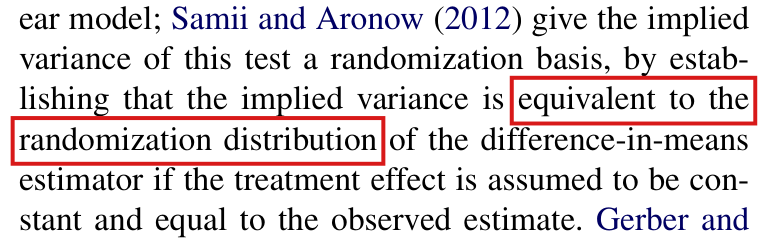
Samii and Aronow (2012) give the implied variance of this test a randomization basis, by establishing that the implied variance is equivalent to the randomization distribution of the difference-in-means estimator if the treatment effect is assumed to be constant and equal to the observed estimate.

Intended meaning

As printed, the sentence compares a variance with a distribution. The intended comparison is with the variance of that distribution. The equivalence is asymptotic, which is the scope that the Introduction (p. 346) sets for the whole comment, and with this reading the statement is correct. Let SSR\text{SSR} be the residual sum of squares from the regression of the outcome on a constant and the treatment indicator. When the outcomes are imputed under a constant effect equal to the observed estimate, the randomization distribution of the difference in means has variance N SSR/(N1N0(N−1))N\,\text{SSR}/(N_1 N_0 (N-1)). This is (N−2)/(N−1)(N-2)/(N-1) times the usual estimate V^(OLS)=N SSR/(N1N0(N−2))\widehat{V}(\text{OLS}) = N\,\text{SSR}/(N_1 N_0 (N-2)), and the factor tends to 11. No result in the comment depends on the sentence. Samii and Aronow (2012) was not consulted.

Corrected

Samii and Aronow (2012) give the implied variance of this test a randomization basis, by establishing that the implied variance is equivalent to the variance of the randomization distribution of the difference-in-means estimator if the treatment effect is assumed to be constant and equal to the observed estimate.

Crop of six lines in the right column of page 346. They read: ear model; Samii and Aronow (2012) give the implied variance of this test a randomization basis, by establishing that the implied variance is equivalent to the randomization distribution of the difference-in-means estimator if the treatment effect is assumed to be constant and equal to the observed estimate. Gerber and. Two red outlines surround the words equivalent to the, at the end of the third line, and randomization distribution, at the start of the fourth line.
Section 2, first paragraph, p. 346 (PDF p. 1), right column. The outlines mark “equivalent to the randomization distribution”, which runs over two lines.

Formal statements (Lean)

Formal results: 7 whole; 1 restricted; 0 refuted; 0 omitted.

Coverage concerns the identified claim under its stated assumptions. A checked proof establishes the formal statement; correspondence to the published text was reviewed by AI. Repository access is currently required to open the source links.

Each result links to its current formal statement and proof. “Whole” covers the identified claim under its assumptions; “restricted” covers the stated narrower scope; “refuted” gives a counterexample to the identified assertion; “omitted” has no current theorem. Any named published theorem used as a premise remains an assumption. Browse the formal results for this work.

Section 4 (‘A Note on Theorem 7’), the unnumbered replacement claim (‘a weaker claim verifiable at full generality’), with the domain of ‘all test statistics’ made explicit (statistics of the two-by-two treatment-by-outcome table); announced as contribution (iii) of the Introduction

p. 348 (PDF p. 3), Section 4, foot of the left column and top of the right column; Introduction, item (iii), p. 346 (PDF p. 1)

Section 4, p. 348 (PDF p. 3); Introduction (iii), p. 346 (PDF p. 1). For fixed binary sharp-null outcomes, the difference in means identifies the table, every table statistic has the explicit common factor, symmetric arm-sample statistics are table statistics, and table constancy exactly characterizes factorization.

Historical component credits
  • Proved AronowAudit.P053.binary_reconstruction Historical support retained; baseline fidelity: ok; manifest: used; used in Solution; Auxiliary identity or symmetry fact is already contained in the primary identification and ordered-sample declarations used here.
  • Proved AronowAudit.P053.binary_equal_iff Historical support retained; baseline fidelity: ok; manifest: used; used in Solution; Auxiliary identity or symmetry fact is already contained in the primary identification and ordered-sample declarations used here.
  • Proved AronowAudit.P053.binary_support_identification Historical support retained; baseline fidelity: ok; manifest: used; used in Solution; The full support and both assignment quantifiers match T1(a)-(b); unused membership premises inside a proof are not a difference in the exported statement.
  • Proved AronowAudit.P053.explicit_table_factor Historical support retained; baseline fidelity: ok; manifest: used; used in Solution; No uniformity over different totals M is claimed or needed. Infeasible values M>n1+n0 make only the conditional y-branch empty; feasible M, such as the explicit instance, are nonvacuous.
  • Proved AronowAudit.P053.table_statistic_factors Limited support; baseline fidelity: narrower; manifest: used; used in Solution; Its narrower fixed-outcome-vector existence statement omits the M-only common choice; explicit_table_factor supplies that choice directly.
  • Proved AronowAudit.P053.factor_iff_table_constant Historical support retained; baseline fidelity: ok; manifest: used; used in Solution; The assignment subtype is exactly the entire support. No separate inhabitance of S is needed because the assignment domain is nonempty and T supplies a value of S.
  • Proved AronowAudit.P053.successes_permutation Historical support retained; baseline fidelity: ok; manifest: used; used in Solution; Auxiliary identity or symmetry fact is already contained in the primary identification and ordered-sample declarations used here.
  • Proved AronowAudit.P053.canonical_permutation Historical support retained; baseline fidelity: ok; manifest: used; used in Solution; Auxiliary identity or symmetry fact is already contained in the primary identification and ordered-sample declarations used here.
  • Proved AronowAudit.P053.symmetric_binary_samples Historical support retained; baseline fidelity: ok; manifest: used; used in Solution; Auxiliary identity or symmetry fact is already contained in the primary identification and ordered-sample declarations used here.
  • Proved AronowAudit.P053.table_samples_invariant Historical support retained; baseline fidelity: ok; manifest: used; used in Solution; There is no monotonicity restriction on h and no assumed invariance of h; the equality follows from the unchanged table counts. The record’s asymptotic boilerplate does not describe this target.
  • Proved AronowAudit.P053.symmetric_samples_table_iff Historical support retained; baseline fidelity: ok; manifest: not used; not used in Solution; Auxiliary identity or symmetry fact is already contained in the primary identification and ordered-sample declarations used here.
  • Proved AronowAudit.P053.ordered_sample_successes Historical support retained; baseline fidelity: ok; manifest: used; used in Solution; Auxiliary identity or symmetry fact is already contained in the primary identification and ordered-sample declarations used here.
  • Proved AronowAudit.P053.successes_compl Historical support retained; baseline fidelity: ok; manifest: used; used in Solution; Auxiliary identity or symmetry fact is already contained in the primary identification and ordered-sample declarations used here.
  • Proved AronowAudit.P053.binary_control_card Historical support retained; baseline fidelity: ok; manifest: used; used in Solution; Harmless extension; this is an auxiliary cardinality fact for T1(d), not a claim about a zero-denominator difference in means. The record’s asymptotic boilerplate does not describe this target.
  • Proved AronowAudit.P053.ordered_sample_statistic_factors Historical support retained; baseline fidelity: ok; manifest: used; used in Solution; The canonical equality exports the required h_F value by expansion, and the same g is quantified before every supported assignment. The global invariance premise is already required by T1(d).

Section 4 (‘A Note on Theorem 7’), the unnumbered replacement claim as printed, read with no restriction on ‘all test statistics’; the witnesses are the validators' constructions and are not in the paper

p. 348 (PDF p. 3), Section 4, foot of the left column and top of the right column

Section 4, p. 348 (PDF p. 3). The specified four-unit and repeated-block examples refute the unrestricted reading allowing labelled and fixed-covariate statistics. Both statistics have the stated values and fail to factor through the difference in means. The six four-unit assignments each have probability 1/6. The same repeated populations have means 1/2, variances m/(4m-1), zero effect variance and average effect, raw fourth-moment average one, and the full S5 regularity certificate with limits (1/2,1/4,1/4,0,0). The usual measure-theoretic conditions are assumed and hold automatically here.

Historical component credits
  • Counterexample proved AronowAudit.P053.four_counterexample_values Historical support retained; baseline fidelity: ok; manifest: used; used in Solution; This is the numerical witness component of T2 under its explicitly unrestricted reading; it is not a positive factorization theorem.
  • Counterexample proved AronowAudit.P053.unrestricted_counterexample Historical support retained; baseline fidelity: ok; manifest: used; used in Solution; Exact for the target’s specified unrestricted class, which expressly admits label and fixed-covariate statistics; it does not refute the natural table-statistic restriction discussed in the record.
  • Proved AronowAudit.P053.product_successes Historical support retained; baseline fidelity: ok; manifest: used; used in Solution; Auxiliary repeated-count or moment fact is already included in the repeated values/scaling declarations used here.
  • Proved AronowAudit.P053.repeated_total Historical support retained; baseline fidelity: ok; manifest: used; used in Solution; Auxiliary repeated-count or moment fact is already included in the repeated values/scaling declarations used here.
  • Counterexample proved AronowAudit.P053.repeated_counterexample_values Historical support retained; baseline fidelity: ok; manifest: used; used in Solution; Natural m>0 exactly represents integer block counts m≥1, and the product label set changes no assignments in the complete design.
  • Counterexample proved AronowAudit.P053.unrestricted_repeated_counterexample Historical support retained; baseline fidelity: ok; manifest: used; used in Solution; The public description explicitly limits the refutation to the unrestricted reading and matches this statement. Membership in support allows all 2m-subsets, including assignments mixing blocks.
  • Proved AronowAudit.P053.repeated_fourth_moments Historical support retained; baseline fidelity: ok; manifest: used; used in Solution; Auxiliary repeated-count or moment fact is already included in the repeated values/scaling declarations used here.
  • Proved AronowAudit.P053.repeated_counterexample_scaling Historical support retained; baseline fidelity: ok; manifest: used; used in Solution; The statement covers the listed scaling and moment certificates; nonfactorization at each size is separately exported by R278-08, as the original row description says.

Section 4 (‘A Note on Theorem 7’), unnumbered: the objection to the quoted Theorem 7 of Ding (2017), that a test statistic that is not strictly increasing in the difference in means (e.g., ∣τ^∣|\widehat{\tau}|) can give different inferences

p. 348 (PDF p. 3), Section 4, left column; Introduction, item (iii), p. 346 (PDF p. 1)

Section 4, p. 348 (PDF p. 3); Introduction (iii), p. 346 (PDF p. 1). Absolute differences and signed differences give the specified distinct inclusive upper-tail p-values on six and four units, whereas strictly increasing transformations preserve those p-values.

Historical component credits
  • Proved AronowAudit.P053.increasing_same_p Historical support retained; baseline fidelity: ok; manifest: used; used in Solution; Specializing T to the actual difference of means for any real outcome vector proves all of T3(c); the Bool-only binaryTau definition imposes no restriction on this generic theorem.
  • Proved AronowAudit.P053.binary_order_iff Historical support retained; baseline fidelity: ok; manifest: used; used in Solution; Auxiliary order or tail-count fact is already included in the complete six-unit and four-unit inference declarations used here.
  • Proved AronowAudit.P053.binary_upperP_count Historical support retained; baseline fidelity: ok; manifest: used; used in Solution; Auxiliary order or tail-count fact is already included in the complete six-unit and four-unit inference declarations used here.
  • Proved AronowAudit.P053.balanced_absolute_tail Historical support retained; baseline fidelity: ok; manifest: used; used in Solution; Auxiliary order or tail-count fact is already included in the complete six-unit and four-unit inference declarations used here.
  • Proved AronowAudit.P053.six_upper_tail_difference Historical support retained; baseline fidelity: ok; manifest: used; used in Solution; The opposite decisions use the target’s specified rejection convention p≤1/20. As in T3 itself, this is a finite upper-tail example, not an asymptotic separation result.
  • Proved AronowAudit.P053.six_difference_distribution Historical support retained; baseline fidelity: ok; manifest: used; used in Solution; The counts and affine formula are the entire distribution component explicitly assigned to this row, with no asymptotic assertion credited.
  • Proved AronowAudit.P053.four_absolute_endpoint Historical support retained; baseline fidelity: ok; manifest: used; used in Solution; Auxiliary order or tail-count fact is already included in the complete six-unit and four-unit inference declarations used here.
  • Proved AronowAudit.P053.four_upper_tail_difference Historical support retained; baseline fidelity: ok; manifest: used; used in Solution; The target explicitly compares inclusive upper tails of two different statistics; these p-values do not claim that two implementations of the same two-sided test differ.

Section 3 (‘Comparing Wald to Wald, or the return of the Behrens–Fisher problem’), unnumbered: the condition under which the apparent paradox emerges and the bracketed note that restates it

p. 348 (PDF p. 3), Section 3, left column

Section 3, p. 348 (PDF p. 3). The variance-limit inequality has exactly the stated allocation/standard-deviation sign criterion, with the stated difference identity.

Historical component credits
  • Proved AronowAudit.P053.limit_difference_identity Historical support retained; baseline fidelity: ok; manifest: used; used in Solution; The formula is purely algebraic; no asymptotic result is smuggled in by its name, and nonnegativity is unnecessary when only squares are compared.
  • Proved AronowAudit.P053.apparent_paradox_condition Historical support retained; baseline fidelity: ok; manifest: used; used in Solution; The target is the printed bracketed algebraic equivalence; establishing the estimator probability limits or a test-power comparison is outside this row and target.

Section 2 (‘A Wald-type analogue to the Fisher randomization test’), unnumbered displays for V^(Fisher)\widehat{V}(\text{Fisher}), V^(OLS)\widehat{V}(\text{OLS}) and V^(Fisher)−V^(OLS)=τ2/N+op(N−1)\widehat{V}(\text{Fisher})-\widehat{V}(\text{OLS})=\tau^2/N+o_p(N^{-1}); Introduction, item (i)

p. 347 (PDF p. 2), Section 2, foot of the left column and top of the right column; Introduction, item (i), p. 346 (PDF p. 1)

Section 2, p. 347 (PDF p. 2); Introduction (i), p. 346 (PDF p. 1). Under S5, Fisher and pooled OLS variances have all three stated first-order expansions and both stated scaled probability limits.

Historical component credits
  • Proved AronowAudit.P053.centeredSS_raw Historical support retained; baseline fidelity: ok; manifest: used; used in Solution; Finite sampling or algebraic auxiliary is already used by the primary asymptotic declaration; no extra finite clause belongs to this target.
  • Proved AronowAudit.P053.support_positive Historical support retained; baseline fidelity: ok; manifest: used; used in Solution; Finite sampling or algebraic auxiliary is already used by the primary asymptotic declaration; no extra finite clause belongs to this target.
  • Proved AronowAudit.P053.arm_cards Historical support retained; baseline fidelity: ok; manifest: used; used in Solution; Finite sampling or algebraic auxiliary is already used by the primary asymptotic declaration; no extra finite clause belongs to this target.
  • Proved AronowAudit.P053.residualSS_sample_variances Historical support retained; baseline fidelity: ok; manifest: used; used in Solution; Finite sampling or algebraic auxiliary is already used by the primary asymptotic declaration; no extra finite clause belongs to this target.
  • Proved AronowAudit.P053.randomizationMean_constant Historical support retained; baseline fidelity: ok; manifest: used; used in Solution; Finite sampling or algebraic auxiliary is already used by the primary asymptotic declaration; no extra finite clause belongs to this target.
  • Proved AronowAudit.P053.randomizationProbability_univ Historical support retained; baseline fidelity: ok; manifest: not used; not used in Solution; Finite sampling or algebraic auxiliary is already used by the primary asymptotic declaration; no extra finite clause belongs to this target.
  • Proved AronowAudit.P053.randomizationMean_sub Historical support retained; baseline fidelity: ok; manifest: used; used in Solution; Finite sampling or algebraic auxiliary is already used by the primary asymptotic declaration; no extra finite clause belongs to this target.
  • Proved AronowAudit.P053.randomizationMean_mul Historical support retained; baseline fidelity: ok; manifest: used; used in Solution; Finite sampling or algebraic auxiliary is already used by the primary asymptotic declaration; no extra finite clause belongs to this target.
  • Proved AronowAudit.P053.randomizationMean_sum Historical support retained; baseline fidelity: ok; manifest: used; used in Solution; Finite sampling or algebraic auxiliary is already used by the primary asymptotic declaration; no extra finite clause belongs to this target.
  • Proved AronowAudit.P053.randomizationMean_congr Historical support retained; baseline fidelity: ok; manifest: used; used in Solution; Finite sampling or algebraic auxiliary is already used by the primary asymptotic declaration; no extra finite clause belongs to this target.
  • Proved AronowAudit.P053.marginal_treatment_mean Historical support retained; baseline fidelity: ok; manifest: used; used in Solution; Finite sampling or algebraic auxiliary is already used by the primary asymptotic declaration; no extra finite clause belongs to this target.
  • Proved AronowAudit.P053.randomization_sample_sum Historical support retained; baseline fidelity: ok; manifest: used; used in Solution; Finite sampling or algebraic auxiliary is already used by the primary asymptotic declaration; no extra finite clause belongs to this target.
  • Proved AronowAudit.P053.estimate_sample_sum Historical support retained; baseline fidelity: ok; manifest: used; used in Solution; Finite sampling or algebraic auxiliary is already used by the primary asymptotic declaration; no extra finite clause belongs to this target.
  • Proved AronowAudit.P053.difference_in_means_unbiased Historical support retained; baseline fidelity: ok; manifest: used; used in Solution; Finite sampling or algebraic auxiliary is already used by the primary asymptotic declaration; no extra finite clause belongs to this target.
  • Proved AronowAudit.P053.joint_treatment_mean Historical support retained; baseline fidelity: ok; manifest: used; used in Solution; Finite sampling or algebraic auxiliary is already used by the primary asymptotic declaration; no extra finite clause belongs to this target.
  • Proved AronowAudit.P053.treatment_product_mean Historical support retained; baseline fidelity: ok; manifest: used; used in Solution; Finite sampling or algebraic auxiliary is already used by the primary asymptotic declaration; no extra finite clause belongs to this target.
  • Proved AronowAudit.P053.randomization_sample_square Historical support retained; baseline fidelity: ok; manifest: used; used in Solution; Finite sampling or algebraic auxiliary is already used by the primary asymptotic declaration; no extra finite clause belongs to this target.
  • Proved AronowAudit.P053.randomizationVariance_raw Historical support retained; baseline fidelity: ok; manifest: used; used in Solution; Finite sampling or algebraic auxiliary is already used by the primary asymptotic declaration; no extra finite clause belongs to this target.
  • Proved AronowAudit.P053.randomization_sample_variance Historical support retained; baseline fidelity: ok; manifest: used; used in Solution; Finite sampling or algebraic auxiliary is already used by the primary asymptotic declaration; no extra finite clause belongs to this target.
  • Proved AronowAudit.P053.sampleMean_linear Historical support retained; baseline fidelity: ok; manifest: used; used in Solution; Finite sampling or algebraic auxiliary is already used by the primary asymptotic declaration; no extra finite clause belongs to this target.
  • Proved AronowAudit.P053.randomizationVariance_congr Historical support retained; baseline fidelity: ok; manifest: used; used in Solution; Finite sampling or algebraic auxiliary is already used by the primary asymptotic declaration; no extra finite clause belongs to this target.
  • Proved AronowAudit.P053.randomizationVariance_sub_constant Historical support retained; baseline fidelity: ok; manifest: used; used in Solution; Finite sampling or algebraic auxiliary is already used by the primary asymptotic declaration; no extra finite clause belongs to this target.
  • Proved AronowAudit.P053.weighted_potential_variance Historical support retained; baseline fidelity: ok; manifest: used; used in Solution; Finite sampling or algebraic auxiliary is already used by the primary asymptotic declaration; no extra finite clause belongs to this target.
  • Proved AronowAudit.P053.difference_in_means_variance Historical support retained; baseline fidelity: ok; manifest: used; used in Solution; Finite sampling or algebraic auxiliary is already used by the primary asymptotic declaration; no extra finite clause belongs to this target.
  • Proved AronowAudit.P053.randomizationMean_div Historical support retained; baseline fidelity: ok; manifest: not used; not used in Solution; Finite sampling or algebraic auxiliary is already used by the primary asymptotic declaration; no extra finite clause belongs to this target.
  • Proved AronowAudit.P053.randomizationVariance_scale Historical support retained; baseline fidelity: ok; manifest: not used; not used in Solution; Finite sampling or algebraic auxiliary is already used by the primary asymptotic declaration; no extra finite clause belongs to this target.
  • Proved AronowAudit.P053.difference_sample_sum Historical support retained; baseline fidelity: ok; manifest: not used; not used in Solution; Finite sampling or algebraic auxiliary is already used by the primary asymptotic declaration; no extra finite clause belongs to this target.
  • Proved AronowAudit.P053.reference_difference_mean Historical support retained; baseline fidelity: ok; manifest: not used; not used in Solution; Finite sampling or algebraic auxiliary is already used by the primary asymptotic declaration; no extra finite clause belongs to this target.
  • Proved AronowAudit.P053.reference_difference_variance Historical support retained; baseline fidelity: ok; manifest: not used; not used in Solution; Finite sampling or algebraic auxiliary is already used by the primary asymptotic declaration; no extra finite clause belongs to this target.
  • Proved AronowAudit.P053.sampleVariance_congr Historical support retained; baseline fidelity: ok; manifest: used; used in Solution; Finite sampling or algebraic auxiliary is already used by the primary asymptotic declaration; no extra finite clause belongs to this target.
  • Proved AronowAudit.P053.treated_sample_variance_unbiased Historical support retained; baseline fidelity: ok; manifest: not used; not used in Solution; Finite sampling or algebraic auxiliary is already used by the primary asymptotic declaration; no extra finite clause belongs to this target.
  • Proved AronowAudit.P053.randomization_control_sum Historical support retained; baseline fidelity: ok; manifest: not used; not used in Solution; Finite sampling or algebraic auxiliary is already used by the primary asymptotic declaration; no extra finite clause belongs to this target.
  • Proved AronowAudit.P053.randomization_control_variance Historical support retained; baseline fidelity: ok; manifest: not used; not used in Solution; Finite sampling or algebraic auxiliary is already used by the primary asymptotic declaration; no extra finite clause belongs to this target.
  • Proved AronowAudit.P053.randomization_control_square Historical support retained; baseline fidelity: ok; manifest: not used; not used in Solution; Finite sampling or algebraic auxiliary is already used by the primary asymptotic declaration; no extra finite clause belongs to this target.
  • Proved AronowAudit.P053.control_sample_variance_unbiased Historical support retained; baseline fidelity: ok; manifest: not used; not used in Solution; Finite sampling or algebraic auxiliary is already used by the primary asymptotic declaration; no extra finite clause belongs to this target.
  • Proved AronowAudit.P053.treated_variance_observed Historical support retained; baseline fidelity: ok; manifest: used; used in Solution; Finite sampling or algebraic auxiliary is already used by the primary asymptotic declaration; no extra finite clause belongs to this target.
  • Proved AronowAudit.P053.control_variance_observed Historical support retained; baseline fidelity: ok; manifest: used; used in Solution; Finite sampling or algebraic auxiliary is already used by the primary asymptotic declaration; no extra finite clause belongs to this target.
  • Proved AronowAudit.P053.randomizationMean_add Historical support retained; baseline fidelity: ok; manifest: not used; not used in Solution; Finite sampling or algebraic auxiliary is already used by the primary asymptotic declaration; no extra finite clause belongs to this target.
  • Proved AronowAudit.P053.combined_variance_decomposition Historical support retained; baseline fidelity: ok; manifest: used; used in Solution; Finite sampling or algebraic auxiliary is already used by the primary asymptotic declaration; no extra finite clause belongs to this target.
  • Proved AronowAudit.P053.frt_reference_variance Historical support retained; baseline fidelity: ok; manifest: not used; not used in Solution; Finite sampling or algebraic auxiliary is already used by the primary asymptotic declaration; no extra finite clause belongs to this target.
  • Proved AronowAudit.P053.ols_pooled_formula Historical support retained; baseline fidelity: ok; manifest: used; used in Solution; Finite sampling or algebraic auxiliary is already used by the primary asymptotic declaration; no extra finite clause belongs to this target.
  • Proved AronowAudit.P053.fisher_ols_exact Historical support retained; baseline fidelity: ok; manifest: used; used in Solution; Finite sampling or algebraic auxiliary is already used by the primary asymptotic declaration; no extra finite clause belongs to this target.
  • Proved AronowAudit.P053.neyman_randomization_identity Historical support retained; baseline fidelity: ok; manifest: not used; not used in Solution; Finite sampling or algebraic auxiliary is already used by the primary asymptotic declaration; no extra finite clause belongs to this target.
  • Proved AronowAudit.P053.arm_variances_unbiased Historical support retained; baseline fidelity: ok; manifest: not used; not used in Solution; Finite sampling or algebraic auxiliary is already used by the primary asymptotic declaration; no extra finite clause belongs to this target.
  • Proved AronowAudit.P053.fisher_ols_asymptotics Historical support retained; baseline fidelity: ok; manifest: used; used in Solution; The explicit S5 conditions govern this comparison; the target expressly excludes the interpretive claims about suboptimality and Rao/Wald tests, and no cited-source theorem is a Lean premise. No change from the saved claim-stage verdict.

Section 2, unnumbered statements on the Wald-type analogue: a Wald-type test using V^(OLS)\widehat{V}(\text{OLS}) is an asymptotically valid test of Fisher's null, and V^(Fisher)−V^(OLS)=op(N−1)\widehat{V}(\text{Fisher})-\widehat{V}(\text{OLS})=o_p(N^{-1}) under local alternatives τN=o(1)\tau_N=o(1); Introduction, item (i)

p. 347 (PDF p. 2), Section 2, foot of the left column and right column; Introduction, item (i), p. 346 (PDF p. 1); the sentence on the randomization basis of the Wald variance is in Section 2, p. 346 (PDF p. 1), right column

Section 2, pp. 346–347 (PDF pp. 1–2); Introduction (i), p. 346. Local effects give the variance difference and ratio limits, constant effects give the two variance approximations, and Fisher's null gives the normal Wald limit and nominal size.

Historical component credits
  • Proved AronowAudit.P053.sampleMean_add_constant Historical support retained; baseline fidelity: ok; manifest: used; used in Solution; Finite translation, constant-effect or imputation auxiliary is already used by the retained asymptotic declarations.
  • Proved AronowAudit.P053.sampleVariance_add_constant Historical support retained; baseline fidelity: ok; manifest: used; used in Solution; Finite translation, constant-effect or imputation auxiliary is already used by the retained asymptotic declarations.
  • Proved AronowAudit.P053.sampleVariance_constant Historical support retained; baseline fidelity: ok; manifest: used; used in Solution; Finite translation, constant-effect or imputation auxiliary is already used by the retained asymptotic declarations.
  • Proved AronowAudit.P053.constant_effect_finite Historical support retained; baseline fidelity: ok; manifest: not used; not used in Solution; Finite translation, constant-effect or imputation auxiliary is already used by the retained asymptotic declarations.
  • Proved AronowAudit.P053.sampleMean_congr Historical support retained; baseline fidelity: ok; manifest: not used; not used in Solution; Finite translation, constant-effect or imputation auxiliary is already used by the retained asymptotic declarations.
  • Proved AronowAudit.P053.centeredSS_congr Historical support retained; baseline fidelity: ok; manifest: not used; not used in Solution; Finite translation, constant-effect or imputation auxiliary is already used by the retained asymptotic declarations.
  • Proved AronowAudit.P053.centeredSS_add_constant Historical support retained; baseline fidelity: ok; manifest: not used; not used in Solution; Finite translation, constant-effect or imputation auxiliary is already used by the retained asymptotic declarations.
  • Proved AronowAudit.P053.fixed_outcome_decomposition Historical support retained; baseline fidelity: ok; manifest: not used; not used in Solution; Finite translation, constant-effect or imputation auxiliary is already used by the retained asymptotic declarations.
  • Proved AronowAudit.P053.imputation_population_variance Historical support retained; baseline fidelity: ok; manifest: not used; not used in Solution; Finite translation, constant-effect or imputation auxiliary is already used by the retained asymptotic declarations.
  • Proved AronowAudit.P053.imputed_reference_variance Historical support retained; baseline fidelity: ok; manifest: not used; not used in Solution; Finite translation, constant-effect or imputation auxiliary is already used by the retained asymptotic declarations.
  • Proved AronowAudit.P053.local_alternative_equivalence Historical support retained; baseline fidelity: ok; manifest: used; used in Solution; This establishes the variance statements T6(a). It does not by itself establish the Introduction's separate test-level equivalence with the FRT; that is a target-coverage issue, not a missing conclusion of this row's stated component.
  • Proved AronowAudit.P053.constant_effect_asymptotics Historical support retained; baseline fidelity: ok; manifest: used; used in Solution; The k-index with N_k→infinity preserves the S5 population-sequence quantifiers. ConstantEffects does not assume a variance or consistency conclusion.
  • Proved AronowAudit.P053.sharp_null_wald_validity Historical support retained; baseline fidelity: ok; manifest: used; used in Solution; CDF convergence is equivalent to weak convergence because the normal CDF is continuous. Positive limiting variance is explicit in T6(c), and occasional zero fitted variances are totalized rather than excluded by an extra hypothesis; the law and critical values are genuine standard-normal objects.

Section 3, unnumbered statements: Neyman's bound lim⁡N→∞NV(τ^)≤S12/p+S02/(1−p)\lim_{N\to\infty}NV(\widehat{\tau})\le S_1^2/p+S_0^2/(1-p), equality under constant effects, agreement of V^(Neyman)\widehat{V}(\text{Neyman}) and V^(OLS)\widehat{V}(\text{OLS}) under constant effects, and the existence of limit distributions for which V^(OLS)\widehat{V}(\text{OLS}) is anticonservative

p. 347 (PDF p. 2), Section 3, foot of the right column, continuing at the top of the left column of p. 348 (PDF p. 3)

Section 3, pp. 347–348 (PDF pp. 2–3). The actual variance obeys Neyman's bound, constant effects give equality and agreement, and the specified heterogeneous Neyman-null sequence has all stated finite formulas and the actual/OLS/Neyman limiting coefficients 81/4, 10 and 85/4.

Historical component credits
  • Proved AronowAudit.P053.constant_effect_variances Historical support retained; baseline fidelity: ok; manifest: used; used in Solution; Auxiliary variance, moment or numerical-limit fact is already included in the bound, agreement and explicit-witness declarations used here.
  • Proved AronowAudit.P053.sampleVariance_scale Historical support retained; baseline fidelity: ok; manifest: used; used in Solution; Auxiliary variance, moment or numerical-limit fact is already included in the bound, agreement and explicit-witness declarations used here.
  • Proved AronowAudit.P053.populationVariance_nonnegative Historical support retained; baseline fidelity: ok; manifest: used; used in Solution; Auxiliary variance, moment or numerical-limit fact is already included in the bound, agreement and explicit-witness declarations used here.
  • Proved AronowAudit.P053.witness_limit_numbers Historical support retained; baseline fidelity: ok; manifest: used; used in Solution; The arithmetic conjunction proves the coefficient comparisons used in the witness component of T8(c).
  • Proved AronowAudit.P053.actual_variance_limit_bound Historical support retained; baseline fidelity: ok; manifest: used; used in Solution; Auxiliary variance, moment or numerical-limit fact is already included in the bound, agreement and explicit-witness declarations used here.
  • Proved AronowAudit.P053.constant_effect_deterministic_limits Historical support retained; baseline fidelity: ok; manifest: used; used in Solution; Auxiliary variance, moment or numerical-limit fact is already included in the bound, agreement and explicit-witness declarations used here.
  • Proved AronowAudit.P053.neyman_asymptotic_bound Historical support retained; baseline fidelity: ok; manifest: used; used in Solution; The statement establishes the actual variance limit, Neyman upper bound, and Neyman-estimator probability limit required by T8(a).
  • Proved AronowAudit.P053.constant_effect_limit_agreement Historical support retained; baseline fidelity: ok; manifest: used; used in Solution; The statement establishes all of T8(b), including the required N-scaled convergence in probability of the OLS-minus-Neyman difference.
  • Proved AronowAudit.P053.witness_potential_moments Historical support retained; baseline fidelity: ok; manifest: used; used in Solution; Auxiliary variance, moment or numerical-limit fact is already included in the bound, agreement and explicit-witness declarations used here.
  • Proved AronowAudit.P053.heterogeneous_witness_finite Historical support retained; baseline fidelity: ok; manifest: used; used in Solution; The statement verifies the exact finite variance and leading-form comparisons for precisely the witness specified in T8(c).
  • Proved AronowAudit.P053.witness_size_diverges Historical support retained; baseline fidelity: ok; manifest: used; used in Solution; Auxiliary variance, moment or numerical-limit fact is already included in the bound, agreement and explicit-witness declarations used here.
  • Proved AronowAudit.P053.witness_variance_base_limit Historical support retained; baseline fidelity: ok; manifest: used; used in Solution; Auxiliary variance, moment or numerical-limit fact is already included in the bound, agreement and explicit-witness declarations used here.
  • Proved AronowAudit.P053.witness_fourth_moments Historical support retained; baseline fidelity: ok; manifest: used; used in Solution; Auxiliary variance, moment or numerical-limit fact is already included in the bound, agreement and explicit-witness declarations used here.
  • Proved AronowAudit.P053.witness_regular Historical support retained; baseline fidelity: ok; manifest: used; used in Solution; Auxiliary variance, moment or numerical-limit fact is already included in the bound, agreement and explicit-witness declarations used here.
  • Proved AronowAudit.P053.witness_actual_scaled_limit Historical support retained; baseline fidelity: ok; manifest: used; used in Solution; Auxiliary variance, moment or numerical-limit fact is already included in the bound, agreement and explicit-witness declarations used here.
  • Proved AronowAudit.P053.anticonservative_limit_exists Historical support retained; baseline fidelity: ok; manifest: used; used in Solution; The concrete regular heterogeneous zero-average-effect sequence establishes every variance and estimator-limit requirement of the existential T8(c).

Section 3, unnumbered display for V^(OLS)−V^(Neyman)\widehat{V}(\text{OLS})-\widehat{V}(\text{Neyman}) and the sentence that S1≠S0S_1\neq S_0 is a necessary condition for the two probability limits to differ; with the display for V^(Neyman)\widehat{V}(\text{Neyman}) of Section 2

p. 347 (PDF p. 2), Section 3, right column; the display for V^(Neyman)\widehat{V}(\text{Neyman}) is at the top of the left column of p. 347, in a sentence that begins on p. 346 (PDF p. 1)

Sections 2–3, p. 347 (PDF p. 2), with the sentence beginning on p. 346. The Neyman and OLS expansions and limits satisfy the stated difference identity and necessary conditions, and the local Fisher comparison has the same expansion and limits.

Historical component credits
  • Proved AronowAudit.P053.wald_leading_difference Historical support retained; baseline fidelity: ok; manifest: not used; not used in Solution; Finite/algebraic auxiliary is already included in the asymptotic comparison; the limit identity is exported there.
  • Proved AronowAudit.P053.wald_leading_zero_iff Historical support retained; baseline fidelity: ok; manifest: not used; not used in Solution; Finite/algebraic auxiliary is already included in the asymptotic comparison; the limit identity is exported there.
  • Proved AronowAudit.P053.pooled_minus_unpooled Historical support retained; baseline fidelity: ok; manifest: not used; not used in Solution; Finite/algebraic auxiliary is already included in the asymptotic comparison; the limit identity is exported there.
  • Proved AronowAudit.P053.ols_neyman_exact Historical support retained; baseline fidelity: ok; manifest: not used; not used in Solution; Finite/algebraic auxiliary is already included in the asymptotic comparison; the limit identity is exported there.
  • Proved AronowAudit.P053.wald_limit_identity Historical support retained; baseline fidelity: ok; manifest: used; used in Solution; Finite/algebraic auxiliary is already included in the asymptotic comparison; the limit identity is exported there.
  • Proved AronowAudit.P053.unequal_wald_limits_necessary Historical support retained; baseline fidelity: ok; manifest: used; used in Solution; The needed specialization is sound; under S5 the v values are nonnegative variance limits, so unequal v values imply unequal nonnegative standard deviations. The theorem is not itself a convergence result. No change from claim-stage.
  • Proved AronowAudit.P053.wald_comparison_asymptotics Historical support retained; baseline fidelity: ok; manifest: used; used in Solution; Establishes all of T7(a)-(c), including both o_p(N^-1) assertions and both genuine uniform-randomization probability limits. The exact S4/S5 interpretation is the comparison standard supplied in the packet; no new integrability, positive-variance or LLN premise is added. No change from claim-stage.
  • Proved AronowAudit.P053.fisher_neyman_local_comparison Historical support retained; baseline fidelity: ok; manifest: used; used in Solution; Covers the stochastic part of T7(d); the universal algebraic rows in this chunk give its remaining deterministic consequences. Regularity contains exactly the stipulated S5 limits and raw fourth-moment bound, not estimator consistency. No change from claim-stage.

Reproduction

What I recalculated or reran from public materials. "Agrees", "Agrees in part" or "Disagrees" compares my result with the printed one. "Not compared" means the comparison could not be made.

Status
Not applicable
Agreement
Not applicable