Assumptions and verification
Claim revision: catalog:9087c89d6914798f9d1849d96bd1c9907a8ae8e21e20b840187c41238419b238
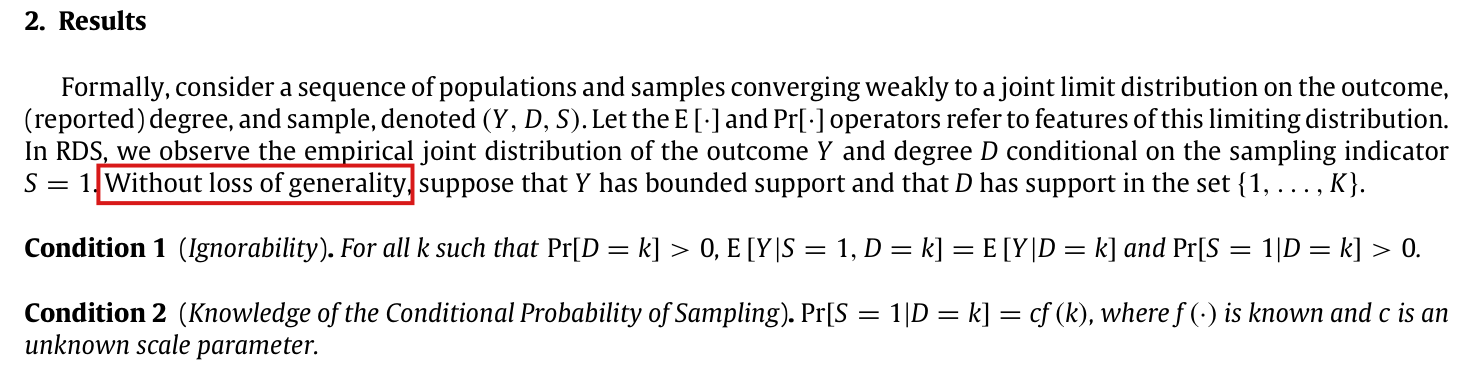
Standing assumptions: The work is a three-page note (Statistics and Probability Letters 106 (2015) 100–102) with one proposition and one corollary. Everything below was read from the rendered page images. [Estimator: Section 1, p. 100 (PDF p. 1)] “Many researchers have approximated RDS as a sampling design in which the sampling probability for subject $i$ is proportional to their network degree $d_i$ (Salganik and Heckathorn, 2004; Volz and Heckathorn, 2008; Gile and Handcock, 2010; Gile, 2011). In particular, Salganik and Heckathorn (2004) and Volz and Heckathorn (2008) justify this choice by modeling the recruitment process as a with-replacement random walk on a connected population network, where only one coupon is given to each subject, recruitment is uniformly at random from network neighbors, and each subject can be recruited infinitely many times. For an RDS sample of size $n$, Volz and Heckathorn (2008) (hereafter VH) give the estimator $$\hat{\mu}_{VH} = \frac{\sum_{i=1}^{n} y_i d_i^{-1}}{\sum_{i=1}^{n} d_i^{-1}} \qquad (1)$$ where $y_i$ is the outcome of interest and $d_i$ is the degree of subject $i$.” [Setting: Section 2, first paragraph, p. 101 (PDF p. 2)] “Formally, consider a sequence of populations and samples converging weakly to a joint limit distribution on the outcome, (reported) degree, and sample, denoted $(Y, D, S)$. Let the $\mathrm{E}[\cdot]$ and $\Pr[\cdot]$ operators refer to features of this limiting distribution. In RDS, we observe the empirical joint distribution of the outcome $Y$ and degree $D$ conditional on the sampling indicator $S = 1$. Without loss of generality, suppose that $Y$ has bounded support and that $D$ has support in the set $\{1, \ldots, K\}$.” [Condition 1: p. 101 (PDF p. 2)] “Condition 1 (Ignorability). For all $k$ such that $\Pr[D = k] > 0$, $\mathrm{E}[Y|S = 1, D = k] = \mathrm{E}[Y|D = k]$ and $\Pr[S = 1|D = k] > 0$.” [Condition 2: p. 101 (PDF p. 2)] “Condition 2 (Knowledge of the Conditional Probability of Sampling). $\Pr[S = 1|D = k] = cf(k)$, where $f(\cdot)$ is known and $c$ is an unknown scale parameter.” [What the paper does not print] The paper gives no further definition of: the sense in which ‘populations and samples’ converge weakly (which empirical measure converges, and in which mode when the sample is random); whether ‘bounded support’ is a bound on each population in the sequence or on the limiting $Y$ only; the range of $k$ in Condition 2 and in the sums of (2) and (4) (Condition 1 alone carries ‘for all $k$ such that $\Pr[D = k] > 0$’); the signs of $c$ and $f$; the words ‘identified’ and ‘consistent’; and how the indicator $S$ and the index $i = 1, \ldots, n$ of (1) are related when a subject can be recruited more than once. [Remarks for the formalizer, not printed in the paper] The readings the audit's validators settled on are: $(Y, D, S)$ has a fixed probability law $F$ on $\mathbb{R} \times \{1, \ldots, K\} \times \{0, 1\}$ with $Y$ bounded, $K$ a positive integer, and $\mathrm{E}$, $\Pr$ are taken under $F$; Conditions 1 and 2 are conditions on $F$; conditional quantities given $D = k$ are used only for $k \in A = \{k : \Pr[D = k] > 0\}$, and Condition 2 and the sums in (2) and (4) are read over $A$ (finding P021-N003, rated a clarity note); the bounds on outcomes and degrees are standing assumptions common to every population in the sequence, not reductions (finding P021-E001, rated a clarity note); the opening sentence of Section 2 is the standing assumption that the realized joint empirical laws of the populations with their samples converge weakly to $F$, in probability if they are random (candidate P021-N004, not confirmed as an error by either validator). [Why the list has two targets] No finding rated as an error in this work concerns a mathematical statement: the two errors (P021-E002 and P021-N001, both Minor) are bibliographic misprints, P021-E001 and P021-N003 are clarity notes, and P021-N002 and P021-N004 were not confirmed. There is therefore no counterexample, corrected-statement or result-touched-by-finding target; what the validators established under the two clarity notes is recorded in the notes of the two targets, because a formal statement needs it. Of the six headline claims, H1 (Proposition 1) and H2 (Corollary 1) are mathematical statements. H3 to H6 (the comparison with the random-walk model, the remark that ignorability given degree alone does not identify the mean, the remark that the two conditions have no directly testable implications, and the remark on diagnostics) are Discussion remarks that both fresh readers classed as interpretive or as a recommendation, and they are not targets.
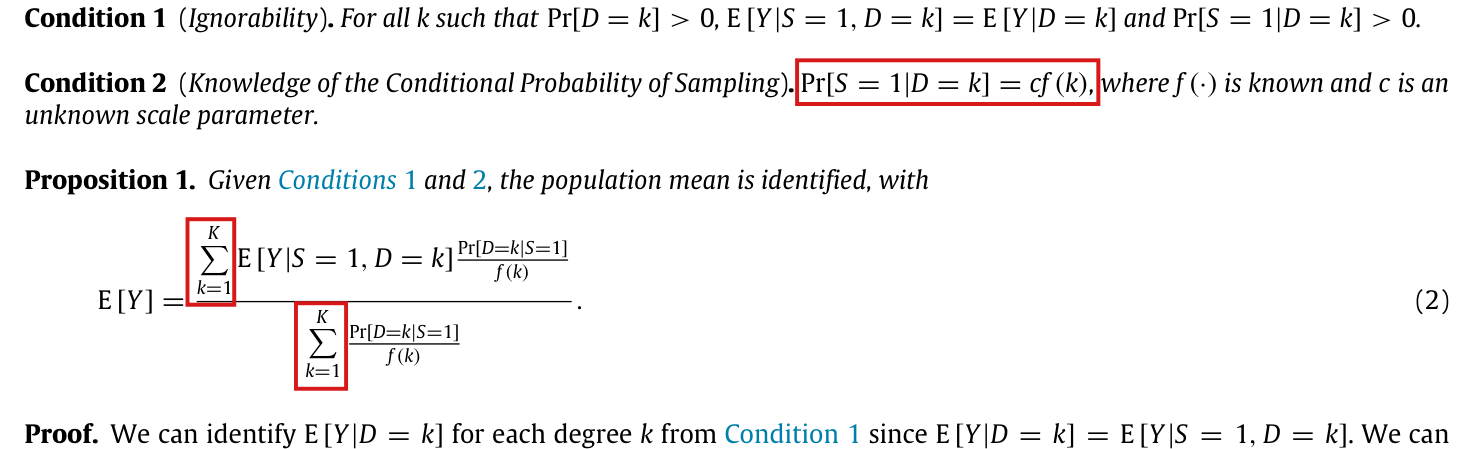
Effective claim (source TeX): [Setting, Section 2, first paragraph, p. 101 (PDF p. 2)] Formally, consider a sequence of populations and samples converging weakly to a joint limit distribution on the outcome, (reported) degree, and sample, denoted $(Y, D, S)$. Let the $\mathrm{E}[\cdot]$ and $\Pr[\cdot]$ operators refer to features of this limiting distribution. In RDS, we observe the empirical joint distribution of the outcome $Y$ and degree $D$ conditional on the sampling indicator $S = 1$. Without loss of generality, suppose that $Y$ has bounded support and that $D$ has support in the set $\{1, \ldots, K\}$. [p. 101] Condition 1 (Ignorability). For all $k$ such that $\Pr[D = k] > 0$, $\mathrm{E}[Y|S = 1, D = k] = \mathrm{E}[Y|D = k]$ and $\Pr[S = 1|D = k] > 0$. [p. 101] Condition 2 (Knowledge of the Conditional Probability of Sampling). $\Pr[S = 1|D = k] = cf(k)$, where $f(\cdot)$ is known and $c$ is an unknown scale parameter. [p. 101] Proposition 1. Given Conditions 1 and 2, the population mean is identified, with $$\mathrm{E}[Y] = \frac{\sum_{k=1}^{K} \mathrm{E}[Y|S = 1, D = k]\,\frac{\Pr[D=k|S=1]}{f(k)}}{\sum_{k=1}^{K} \frac{\Pr[D=k|S=1]}{f(k)}}. \qquad (2)$$ [Proof as printed, p. 101] Proof. We can identify $\mathrm{E}[Y|D = k]$ for each degree $k$ from Condition 1 since $\mathrm{E}[Y|D = k] = \mathrm{E}[Y|S = 1, D = k]$. We can identify each $\Pr[D = k]$ to scale directly from Condition 2 as $$\Pr[D = k] = \frac{\Pr[D = k|S = 1]\,\Pr[S = 1]}{\Pr[S = 1|D = k]} = \frac{\Pr[S = 1]}{c}\,\frac{\Pr[D = k|S = 1]}{f(k)}. \qquad (3)$$ Then by the law of total expectation, $$\mathrm{E}[Y] = \frac{\sum_{k=1}^{K} \mathrm{E}[Y|D = k]\,\frac{\Pr[S=1]}{c}\,\frac{\Pr[D=k|S=1]}{f(k)}}{\sum_{k=1}^{K} \frac{\Pr[S=1]}{c}\,\frac{\Pr[D=k|S=1]}{f(k)}} = \frac{\sum_{k=1}^{K} \mathrm{E}[Y|D = k]\,\frac{\Pr[D=k|S=1]}{f(k)}}{\sum_{k=1}^{K} \frac{\Pr[D=k|S=1]}{f(k)}}. \qquad (4)$$ $\square$ [The hypotheses printed are the setting and Conditions 1 and 2 above. No range of $k$ is printed in Condition 2, and the sums in (2) and (4) are printed from $k = 1$ to $K$.]
: SAP.P021.T1Statement
Theorem: SAP.P021.T1
Statement hash: 3c37adc32060393f1bc7ef54cad9aa2642bf29ac9dae0da2708903e7cf85134a
Statement definition: SAP.P021.T1Statement
Certificate. 20261104T153654Z
Declaration review: faithful; 2026-11-04T15:51:56Z; binding v2
Evidence scope: Certification checks formal proof objects. Statement fidelity is a model judgment. Author review is separate.
Proof dependencies: Independently extracted
Source and evidence metadata · sap-2026-11-08-assured-release