Assumptions and verification
Claim revision: catalog:c7730f348ece475275a0d920e3eb610ed296b8be2c4c159c7a5b06eacd471669
Standing assumptions: The article (Political Communication 31:168–180, 2014; PDF pp. 2–14, PDF p. 1 being the publisher's cover page) is an overview of experimental designs. It has no theorem, no displayed formula, no mathematical notation, no table or figure and no formal model; every statistical claim is made in words. The setting those claims inherit, as printed (read from the page images):
[Basic design and its assumptions: section ‘Between-Subjects Design’, p. 170 (PDF p. 4)] “The most basic experimental design is one in which subjects are assigned individually and with identical probability to treatment or control conditions. Assuming that (a) the random assignments are implemented as planned and outcomes are observed for all subjects, (b) the only systematic factor that causes the treatment group to differ from the control group is the intended treatment, and (c) subjects respond solely to the treatment that they receive (and are unaffected by treatments administered to others), the between-subjects design provides the basis for unbiased estimation of the average causal effect of the treatment in the subject pool (Gerber & Green, 2012). Indeed, the estimation of the average causal effect is simple and intuitive: The average outcome in the control group is subtracted from the average outcome in the treatment group.”
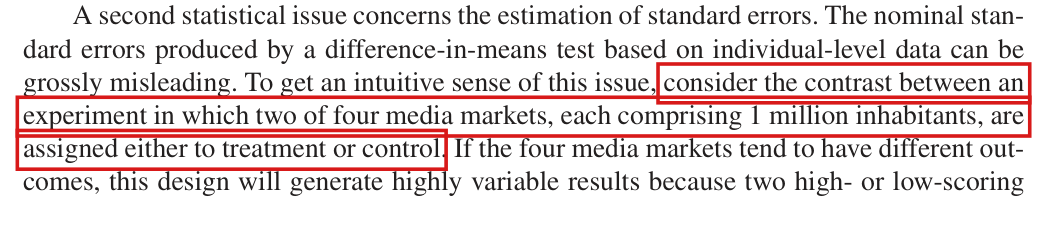
[Clustered design: section ‘Between-Subjects Clustered Design’, p. 171 (PDF p. 5)] “Accordingly, researchers studying the effects of TV or radio randomly assign their treatments to geographic clusters. In effect, all individuals living within the same geographic cluster are assigned together to either treatment or control conditions. In the between-subjects clustered design, clusters are assigned independently, but individuals within clusters are not.”
[Estimand under clustering: p. 172 (PDF p. 6)] “The design suggestions given above presuppose that a researcher’s aim in conducting a clustered experiment is the estimation of an \emph{individual-level} average treatment effect.”
[Randomization inference: p. 172 (PDF p. 6)] “One option in such settings is hypothesis testing based on the method of randomization inference (Fisher, 1935; Rosenbaum, 2002). Under the null hypothesis of no treatment effect whatsoever, one may simulate the sampling distribution of possible estimated treatment effects under all possible random assignments. The $p$ value of the observed estimate is calculated based on its location relative to this randomization distribution.”
[No interference: Note 2, p. 177 (PDF p. 11), attached on p. 171 to the discussion of spillovers in Bond et al.] “2. Modeling spillovers in this way in effect relaxes the assumption that subjects are affected solely by their own treatment status and not the status of others.”
Not stated anywhere in the article: potential-outcome notation; a formula for any estimator; an assignment mechanism beyond the words quoted (complete randomization of a fixed number of units and independent assignment with a common probability both fit “assigned individually and with identical probability” and “clusters are assigned independently”); a sequence of populations for the consistency statement, or any bound on outcomes or on cluster sizes; a sampling model. The formal renderings in the targets below are therefore the audit's, taken from the validators' derivations and from the two readers' exact checks, in finite-population potential-outcome notation: units $i = 1, \ldots, N$ with fixed potential outcomes $Y_i(0)$, $Y_i(1)$; an assignment $Z \in \{0,1\}^N$ that is the only source of randomness (the article's condition (b)); observed outcome $Y_i = Z_iY_i(1) + (1-Z_i)Y_i(0)$ for every unit (conditions (a) and (c)); average effect $\tau = \frac{1}{N}\sum_i [Y_i(1) - Y_i(0)]$.
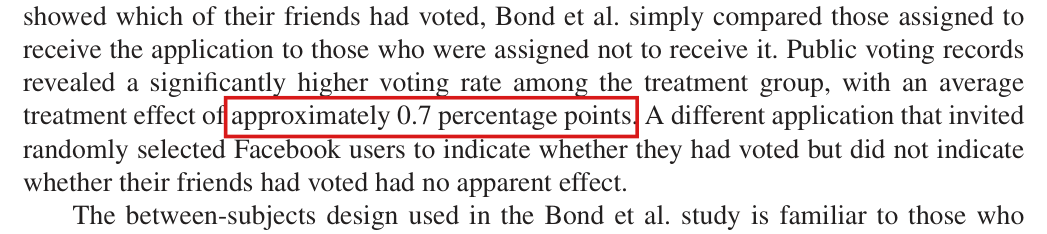
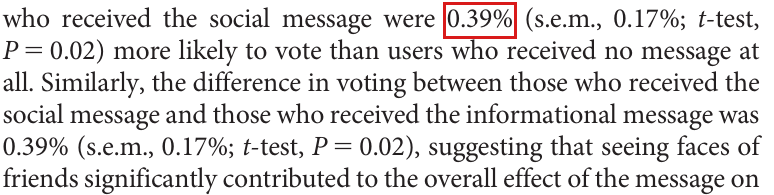
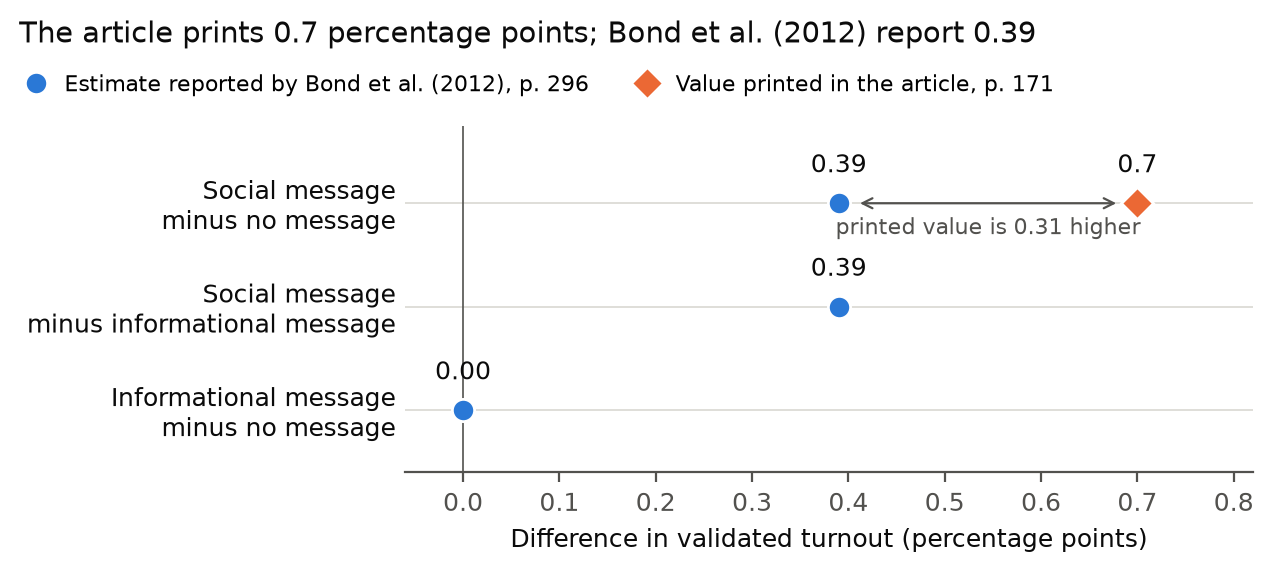
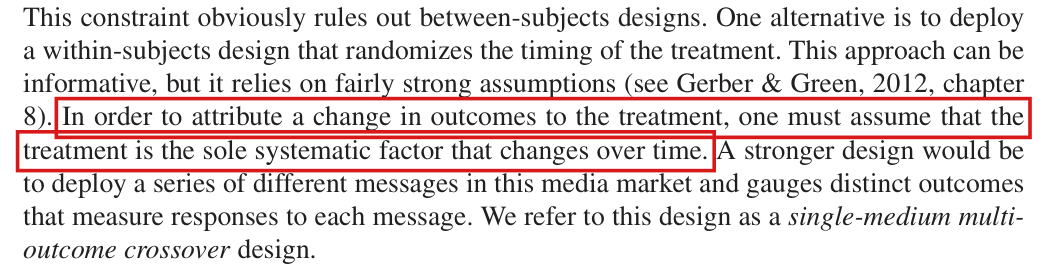
What is and is not a target. Two findings are confirmed errors whose correction changes a mathematical statement: P024-A002 (Moderate; p. 174, the stated necessity of a no-other-change assumption under randomized timing) and P024-E002 (Minor; p. 171, consistency stated without a regularity condition). Each has a counterexample and a corrected statement below. P024-E001 (Moderate) is not a target: it is a misreported statistic from a cited study (p. 171 gives the Bond et al. (2012) effect as approximately 0.7 percentage points where the source reports 0.39), a reporting finding with no mathematical statement to correct, and no claim of the article is derived from the number. The other sixteen error-class findings (P024-E005 to P024-E016, P024-N001, P024-N003, P024-N007, P024-N008) are citation, reference-list, spelling and grammar misprints. Of the nine headline claims, P024-H2, P024-H3 and P024-H5 contain a mathematical statement (unbiasedness; bias and consistency; a weighted-average identity) and are targets; P024-H1, P024-H4, P024-H6, P024-H8 and P024-H9 are framing, qualitative or practical claims; the formal content of P024-H7 (sharp-null randomization tests under a randomized schedule) is part (b) of P024-T2.
Effective claim (source TeX): Sol's replacement for the consistency clause (validated.json, P024-E002, smallest_repair), verbatim: “With uniformly bounded potential outcomes and a common cluster treatment probability bounded away from zero and one, the difference-in-means estimator is consistent as the number of independently assigned clusters grows, provided that no cluster accounts for a nonvanishing share of all subjects.” Sol adds: “For complete cluster randomization, use a treatment fraction bounded away from zero and one. The no-dominance condition is max_j n_j/N -> 0, equivalently sum_j (n_j/N)^2 -> 0.” The rest of the printed sentence (“but bias may be appreciable in studies with only a few dozen clusters of varying size”) is unchanged.
[Corrected statement in full; validator derivation, section 5] [Setting] A sequence of finite populations indexed by $K = 2, 3, \ldots$ The $K$-th population has $K$ clusters with sizes $n_j \ge 1$ ($j = 1, \ldots, K$), $N = \sum_j n_j$ individuals, and fixed potential outcomes $Y_{ij}(0)$, $Y_{ij}(1)$ for individual $i$ of cluster $j$; sizes and outcomes may change with $K$. Put $w_j = n_j/N$, $\bar{Y}_j(z) = n_j^{-1}\sum_i Y_{ij}(z)$, $\mu_z = \sum_j w_j\bar{Y}_j(z)$ and $\tau_K = \mu_1 - \mu_0$, the average treatment effect among all individuals. Clusters are assigned as wholes with indicators $Z_j \in \{0,1\}$; every individual's outcome is observed and equals $Y_{ij}(Z_j)$ (no interference, assignment implemented as planned). The estimator is $$\widehat{\tau}_K = \frac{\sum_j Z_j n_j \bar{Y}_j(1)}{\sum_j Z_j n_j} - \frac{\sum_j (1 - Z_j) n_j \bar{Y}_j(0)}{\sum_j (1 - Z_j) n_j}$$ when both arms are nonempty, and any real number otherwise.
[Hypotheses] (i) [Bounded outcomes] there is $B < \infty$, not depending on $K$, with $|Y_{ij}(z)| \le B$ for all $K$, $j$, $i$, $z$. (ii) [Design] either $Z_1, \ldots, Z_K$ are independent with a common probability $\Pr(Z_j = 1) = p_K$, or the treated set is uniform over the subsets of $m_K$ clusters and $p_K = m_K/K$. (iii) [Interior probability] there is $\eta > 0$, not depending on $K$, with $\eta \le p_K \le 1 - \eta$. (iv) [No dominant cluster] $\max_j w_j \to 0$ as $K \to \infty$.
[Conclusion] For every $\epsilon > 0$, $\Pr(|\widehat{\tau}_K - \tau_K| > \epsilon) \to 0$ as $K \to \infty$. Neither $\tau_K$ nor $p_K$ is required to converge.
[Equivalent form of (iv)] $\max_j w_j \to 0$ if and only if $\sum_j w_j^2 \to 0$.
[What does not hold] Hypotheses (i)–(iii) and $K \to \infty$ without (iv) do not imply the conclusion: P024-T4.
: SAP.P024.T5WholeStatement
Theorem: SAP.P024.T5
Statement hash: 79e03a1316615f5249fd6c1d0b0d3f298a4f058997fe227a171a245cde65737f
Statement definition: SAP.P024.T5WholeStatement
Certificate. 20261104T192849Z
Declaration review: faithful; 2026-11-04T19:44:53Z; binding v2
Evidence scope: Certification checks formal proof objects. Statement fidelity is a model judgment. Author review is separate.
Proof dependencies: Independently extracted
Manifest annotation reconciliation: Effective use follows the source-bound dependency observation; original annotations are retained in the crosswalk.
AronowAudit.P024.assignment_total_complement: observed used
AronowAudit.P024.assignment_total_indicator: observed used
AronowAudit.P024.cluster_population_probability_bound: observed used
AronowAudit.P024.complete_joint_probability: observed used
AronowAudit.P024.complete_marginal: observed used
AronowAudit.P024.complete_pair_inclusion: observed used
AronowAudit.P024.complete_probability_count: observed used
AronowAudit.P024.complete_weighted_moments: observed used
AronowAudit.P024.exchangeable_weighted_moments: observed used
AronowAudit.P024.expectation_mono: observed used
AronowAudit.P024.finite_chebyshev: observed used
AronowAudit.P024.finite_mean_abs_bound: observed used
AronowAudit.P024.finite_ratio_good_event: observed used
AronowAudit.P024.finite_sample_probability_bound: observed used
AronowAudit.P024.finite_variance_identity: observed used
AronowAudit.P024.independent_exclusion_probability: observed used
AronowAudit.P024.independent_marginal: observed used
AronowAudit.P024.independent_pair_moment: observed used
AronowAudit.P024.independent_weighted_moments: observed used
AronowAudit.P024.normalized_total_moments: observed used
AronowAudit.P024.population_effect_normalized: observed used
AronowAudit.P024.population_estimator_normalized: observed used
AronowAudit.P024.population_total_positive: observed used
AronowAudit.P024.probability_bounds: observed used
AronowAudit.P024.probability_mono: observed used
AronowAudit.P024.probability_not: observed used
AronowAudit.P024.probability_union_le: observed used
AronowAudit.P024.ratio_error_bound: observed used
AronowAudit.P024.two_arm_ratio_bound: observed used
AronowAudit.P024.uniform_probability_card: observed used
AronowAudit.P024.variance_const_sub: observed used
AronowAudit.P024.weight_square_bounds: observed used
AronowAudit.P024.weighted_mean_abs_bound: observed used
Source and evidence metadata · sap-2026-11-08-assured-release