P035-E001 Major
The experiment estimates the effect of assignment to the Michelle Obama porch condition; it does not establish that her initiative to reduce childhood obesity caused the difference.
Abstract, Conclusions, first sentence, p. 2/6 (PDF p. 2), and the campaign-effect wording in Results and conclusions, p. 5/6 (PDF p. 5); read with the hypothesis and rationale in the Introduction, third paragraph, p. 2/6
See also under Formal statements (Lean): P035-T1, P035-T3
I disputed this classification, but as a rule, deferred to the models’ final judgment: see my comment and the history of this entry.
As printed
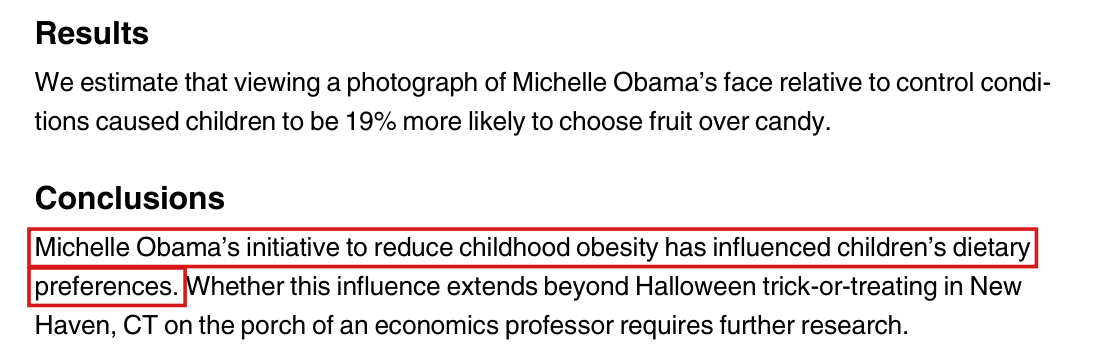
Abstract, Results (p. 2/6). We estimate that viewing a photograph of Michelle Obama’s face relative to control conditions caused children to be 19% more likely to choose fruit over candy.
Abstract, Conclusions (p. 2/6). Michelle Obama’s initiative to reduce childhood obesity has influenced children’s dietary preferences. Whether this influence extends beyond Halloween trick-or-treating in New Haven, CT on the porch of an economics professor requires further research.
Introduction, context (p. 2/6). While the campaign gained publicity, an experimental evaluation of the effects of the entire campaign would not be possible due to the initiative being rolled out across the United States through mass media.
However, we have experimentally assessed the microfoundations of Let’s Move in order to evaluate whether the public health campaign altered dietary decision-making. When children are exposed to the image of a figurehead regularly associated with the public health campaign’s message, the subconscious reminder may reinforce the message.
Results and conclusions (p. 5/6). In particular, this is a strongly Democratic neighborhood, and if children in Democratic households are either more aware of Michelle Obama’s campaign or more favorably disposed to it, we would generate an overestimate of the treatment effect of her campaign on the general population of those in the United States.
The problem
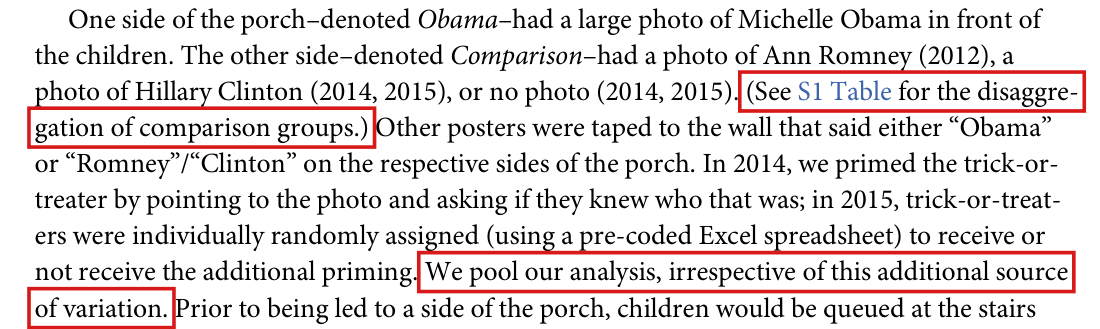
The experiment assigned children to a side of the porch. The Obama side had a large photograph of Michelle Obama and a poster with the name “Obama”; I refer to assignment to this side as the Michelle Obama porch condition. The comparison side had a photograph of Ann Romney (2012) or of Hillary Clinton (2014, 2015), or no photograph (2014, 2015), and posters with the name “Romney” or “Clinton”. Exposure to the Let’s Move campaign, Michelle Obama’s initiative to reduce childhood obesity, was not varied, and the recorded variables include no measure of campaign exposure, recall or the proposed reminder pathway. Under the assumptions of the design (valid assignment, consistency and no interference), the contrast between the two sides estimates the effect of the Michelle Obama porch condition. The first sentence of the Conclusions attributes that effect to the campaign. The attribution requires further assumptions linking at least part of the contrast to the campaign. Recognition of the person, a political association, or another response to the name or the photograph could account for the difference without any campaign contribution. The Introduction explicitly motivates campaign reinforcement through the figurehead’s association with the health message. It proposes this pathway without imposing or testing a restriction that excludes other pathways, or otherwise ensures that some of the contrast comes from the campaign.
The paper says that it cannot evaluate the entire nationwide campaign, and it limits its conclusion to Halloween in New Haven. Neither qualification supplies the missing restriction, since the attribution is not identified even for the children on this porch. The Introduction states a research aim and a proposed explanation: a subconscious reminder may reinforce the campaign’s message. That passage need not be corrected as though it asserted a separately demonstrated mechanism. The categorical attribution is in the abstract’s Conclusions; p. 5/6 continues it by calling the estimate “the treatment effect of her campaign” in its conditional discussion of extrapolation.
The correction weakens the conclusion and changes no number. To establish some campaign contribution, one could assume that noncampaign contributions are zero, or bound their combined contribution below a positive porch-condition effect. The paper supplies neither restriction. The correction does not say that the campaign had no influence, that the proposed explanation is unreasonable, or that there is no contextual evidence favoring it. These data do not settle the actual campaign contribution in either direction. I also do not count the wording of the Results sentence as an error. Since the photograph and the name poster were always assigned together, the design cannot separate their contributions. But “viewing a photograph of Michelle Obama’s face” can reasonably be read as a label for the Michelle Obama porch condition.
Evidence an exact counterexample
The evidence is an exact counterexample: two models of the experiment that agree on everything it can observe and disagree on the effect of the campaign. The mathematical notation is introduced for this check; the paper itself names the Obama and Comparison conditions without defining a mediator or campaign-effect parameter. Fix a year , and let and be the proportions choosing fruit on the comparison side and on the Obama side in the released data. Let be the least common multiple of their denominators, and set and , which are integers. Each child has a latent value , uniform on and independent of the assigned side , where denotes the Obama side. Let indicate whether the campaign is present, so that throughout the study. This counterfactual holds the specified porch displays fixed when the campaign is absent. I write for fruit and for candy, and I define the potential outcomes in the direct-display model and in the campaign-mediated model by
Setting , I have for every and . Since throughout the study, the two models give each child the same outcome on either side, and they give the same distribution to every data set that the experiment can produce, at any sample size. In both models the probability of choosing fruit is on the comparison side and on the Obama side.
The two models differ in the effect of the campaign. In the direct-display model, does not enter the definition, which implies that for every and . In the campaign-mediated model, the difference equals if and otherwise. Taking the mean over the latent value, I obtain
The right side is positive in each of the three years, as the table shows.
| Year | Comparison side, | Obama side, | Direct-display model | Campaign-mediated model |
|---|---|---|---|---|
| 2012 | ||||
| 2014 | ||||
| 2015 |
A quantity that the experiment identifies takes the same value in any two models with the same observable distribution. The effect of the campaign is in the direct-display model and positive in the campaign-mediated model. I conclude that the experiment does not identify it. Both models assume random assignment, consistency and no interference, and in both the Michelle Obama porch condition has an effect. They can also share the stated public association between Michelle Obama and the campaign: in the direct-display model, that association does not affect the choice. Calibration to the observed proportions specifies an exact counterexample; it does not assert that the unknown population probabilities equal those sample proportions.
The construction also respects the disclosed comparison conditions. Applying it separately to each comparison protocol reproduces every integer allocation compatible with S1 Table and the pooled counts: Romney in 2012; Clinton and no photograph in 2014; and either compatible Clinton/no-photograph split in 2015. Averaging over protocols leaves the campaign effect on the Obama side equal to in the campaign-mediated model and zero in the direct-display model. The compatible splits are not recovered participant labels. Both models can include the disclosed 2014 prompting and the separately randomized 2015 prompt with no effect on choice. The paper does not require a nonzero prompt effect, so this completion is permitted. Pooling the prompt is not itself a defect, and these comparisons do not resolve the separate questions about queue assignment or interference.
A recalculation from the released data, with the estimator in the replication code, reproduces the printed estimates. The correction changes none of them.
| Quantity | Printed | Recalculated |
|---|---|---|
| Fruit choice, Obama side (95% interval) | 28.1% (23.8–32.4%) | 0.28066 (0.23751, 0.32381) |
| Fruit choice, comparison side (95% interval) | 23.5% (20.5–26.5%) | 0.23525 (0.20512, 0.26538) |
| Relative increase | 19% | 0.19305 |
| Two-sided | 0.091 | 0.09078 |
What survives
The yearly proportions on each side, the pooled contrast with inverse probability weights, the confidence intervals, the -value and Fig. 1 are unaffected. The 19% relative increase stands as an estimate of the effect of the Michelle Obama porch condition, conditional on the assumptions about assignment, consistency and interference; the questions about assignment in 2014 and 2015 are separate from this correction, and neither the paper nor the released data settle them. What changes is the categorical campaign conclusion and the campaign-effect wording on p. 5/6. The Introduction’s proposed reminder mechanism and stated research purpose can remain, together with the explicit description of the randomized intervention and the geographic, Halloween, repeat-participation and priming qualifications. No later mathematical result depends on the campaign attribution.
Corrected
Abstract, Conclusions. These trials estimate that assignment to the implemented Michelle Obama porch condition increased the probability of choosing raisins rather than candy relative to the pooled comparison conditions. Campaign reinforcement is a possible explanation; the experiment does not establish that the initiative or its health message caused the difference. Whether the estimated porch-condition effect extends beyond Halloween trick-or-treating in New Haven, CT on the porch of an economics professor requires further research.
Results and conclusions, p. 5/6. In particular, this is a strongly Democratic neighborhood, and if children in Democratic households are either more aware of Michelle Obama’s campaign or more favorably disposed to it, we could generate an overestimate of the effect of the implemented Michelle Obama porch condition on the general population of those in the United States.

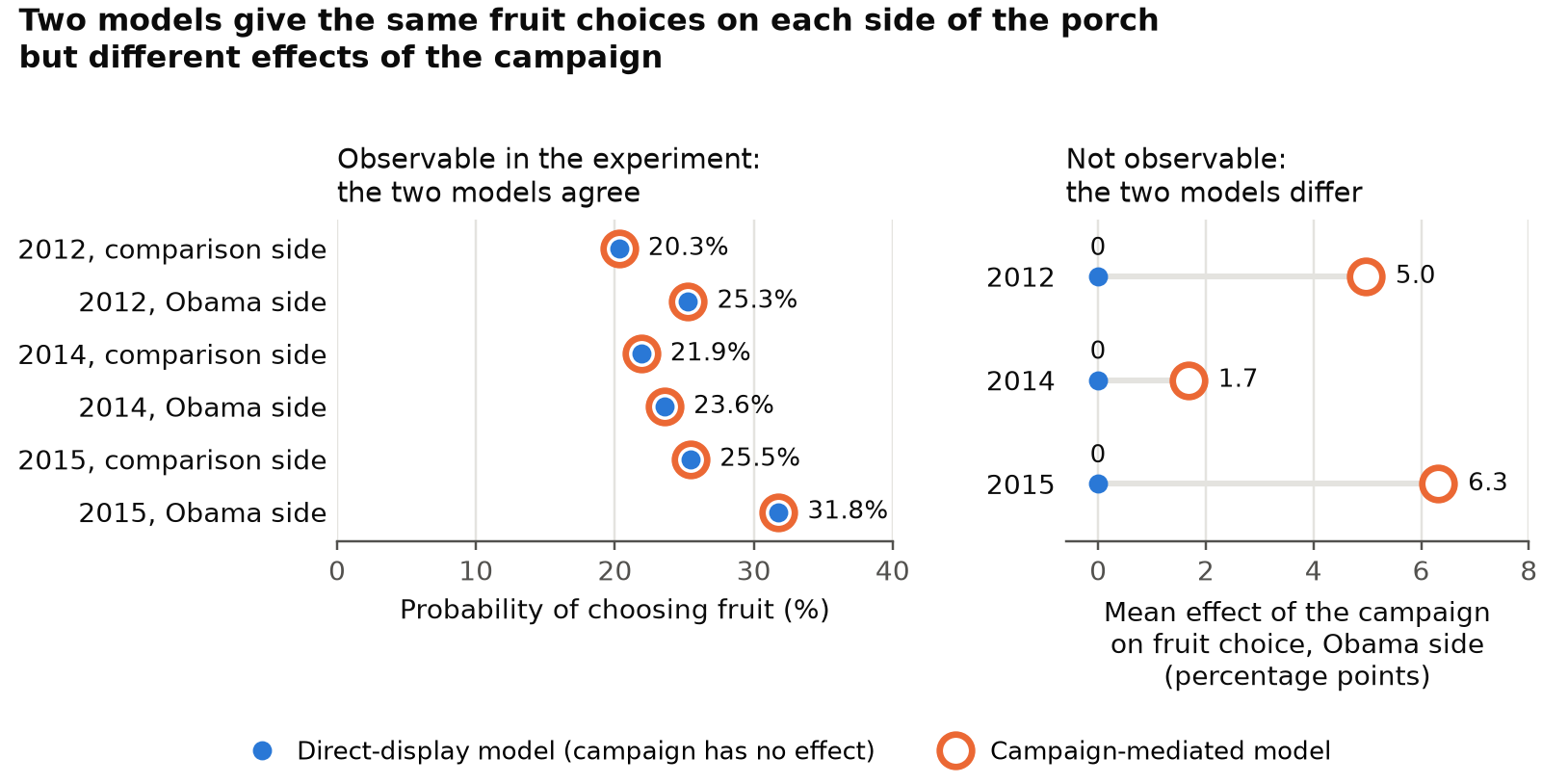
P035-E001, by year. Left: the probability of choosing fruit on each side of the porch, which is the same in the direct-display model (filled dot) and in the campaign-mediated model (open ring) and equals the proportion in the released data. Right: the mean effect of the campaign on fruit choice on the Obama side, which is zero in the direct-display model and 5.0, 1.7 and 6.3 percentage points in the campaign-mediated model.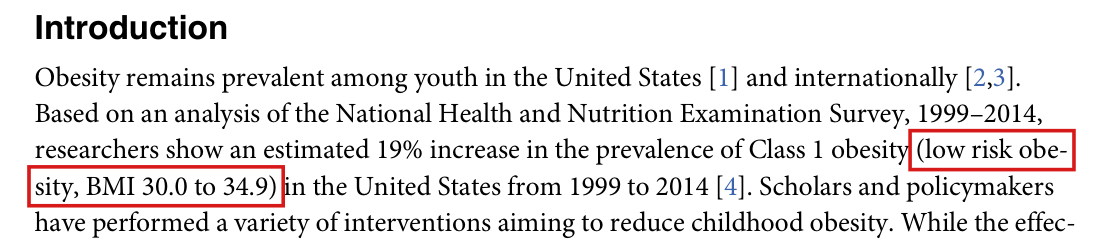

My comment and the history of this entry
Suggested classification: clarity note.
My position My comment above; I suggested a clarity note.
The models’ position The abstract still attributes an effect to the initiative, and p. 5 calls the estimate a campaign effect, although the experiment is consistent with no contribution from the campaign. Major, for that narrower unsupported causal conclusion.