P041-E006 Major
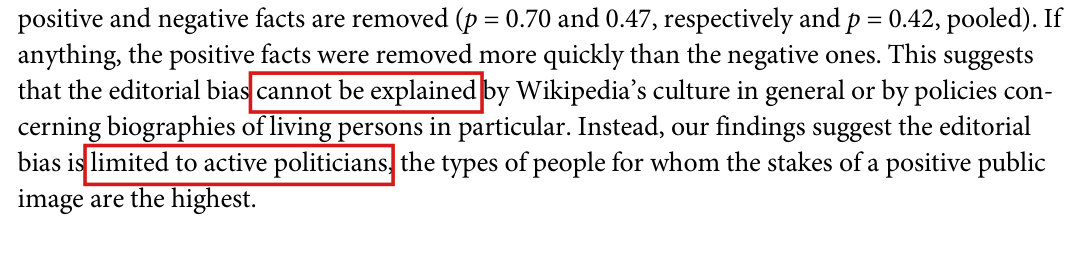
Study 3’s nondetection and smaller early absolute survival differences do not establish that editorial bias is limited to active politicians or is not systemic to Wikipedia, or exclude Wikipedia’s culture or its policy on biographies of living persons as explanations.
“Replication on Wikipedia Pages of Dead and Retired Senators”, last two sentences, p. 5 (PDF p. 5); Discussion, first paragraph, p. 5 (PDF p. 5)
See also under Formal statements (Lean): P041-T1, P041-T2, P041-T11
As printed
End of the section on Study 3, p. 5: “This suggests that the editorial bias cannot be explained by Wikipedia’s culture in general or by policies concerning biographies of living persons in particular. Instead, our findings suggest the editorial bias is limited to active politicians, the types of people for whom the stakes of a positive public image are the highest.”
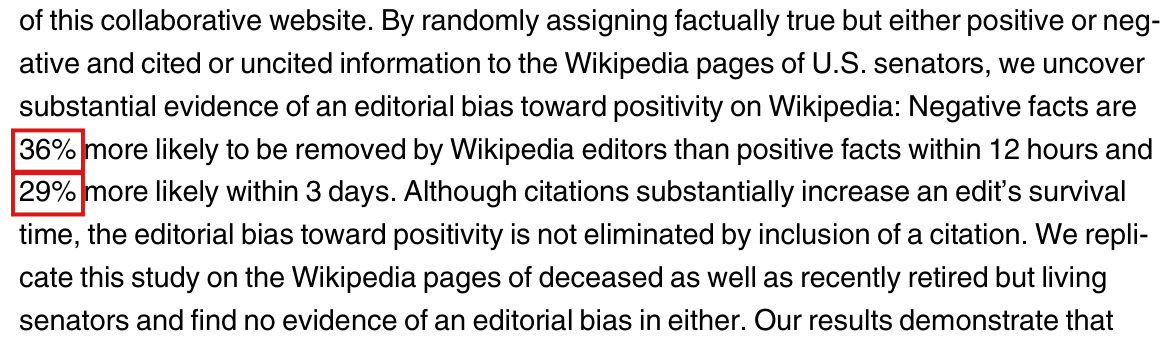
Discussion, p. 5: “In a test conducted on the Wikipedia pages of recently retired and deceased senators, we find no editorial bias, suggesting that this bias is limited to the pages of active politicians and is not systemic to Wikipedia.”
The problem
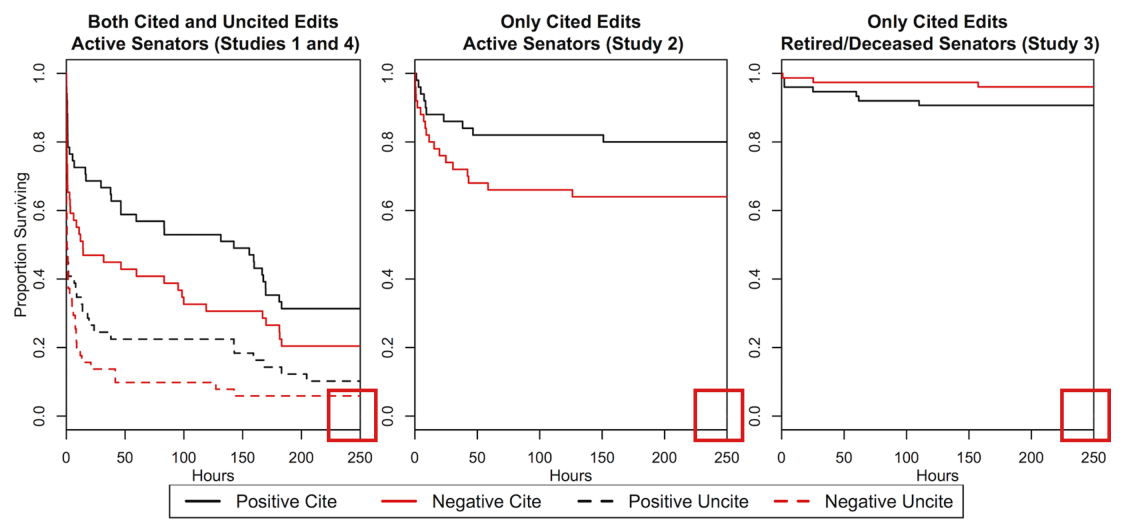
Study 3 added facts to the pages of 151 former senators, and 20 of the facts were removed during the follow-up: 8 of 75 positive facts and 12 of 76 negative facts. The article reports that it finds no difference between the rates at which positive and negative facts are removed ( for living and for deceased former senators, and pooled). Read as a statement that the tests detected no difference, this is correct. The two passages above go further. They conclude that the bias found on the pages of sitting senators is absent elsewhere, and that Wikipedia’s culture and its policy on living persons are excluded as explanations. These conclusions need more than a test that detects no difference. They need evidence that the effect on the pages of former senators is absent, or smaller than the effect on the pages of sitting senators.
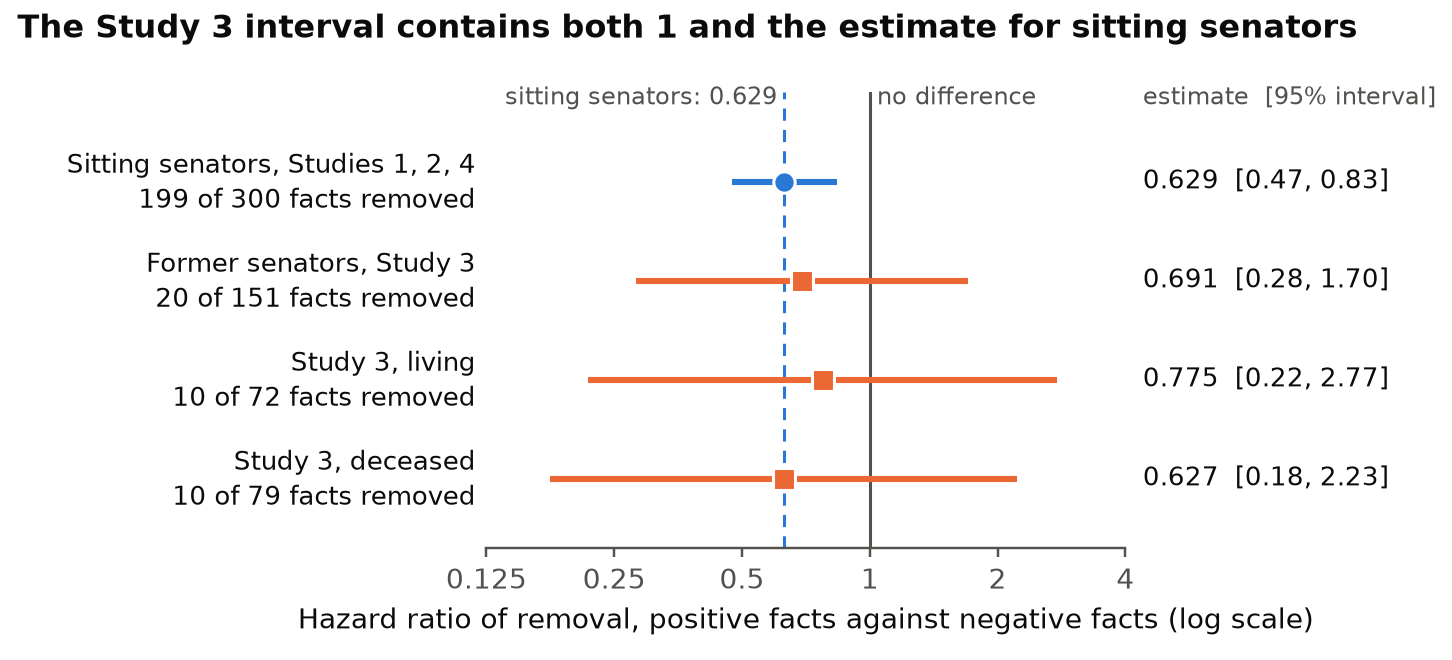
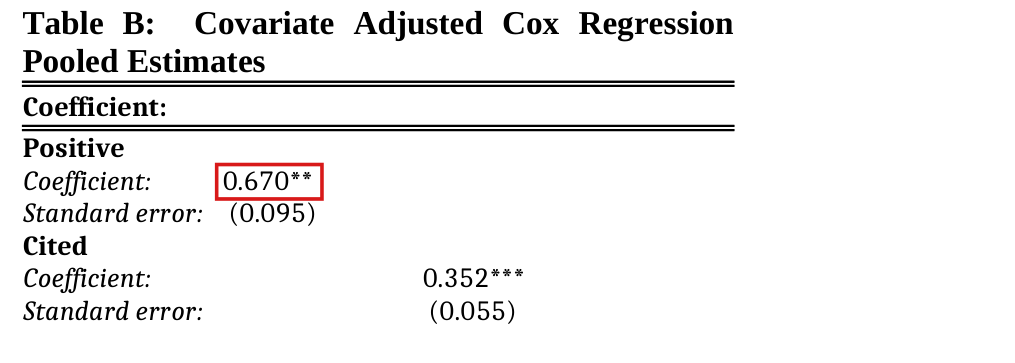
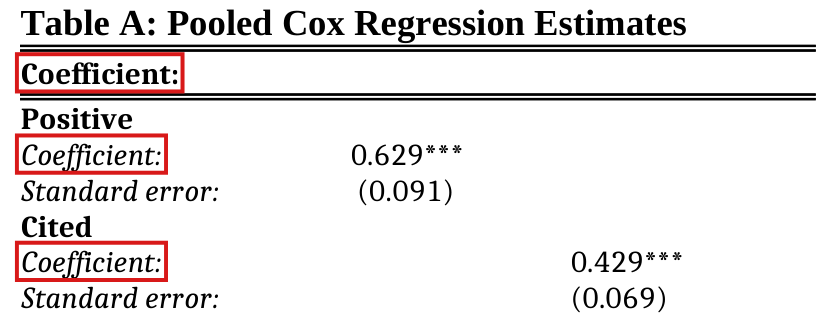
On the primary measure of the article, Study 3 gives no such evidence. The hazard ratio of removal for positive against negative facts is 0.691 for former senators (S6 Table C) and 0.629 for sitting senators (S6 Table A). The 95% interval for former senators runs from 0.28 to 1.70 and contains both 1 and 0.629. Comparing the two hazard ratios directly, I find a ratio of 1.12 with . Study 3 therefore cannot distinguish the absence of bias from a relative bias as large as the one found for sitting senators.
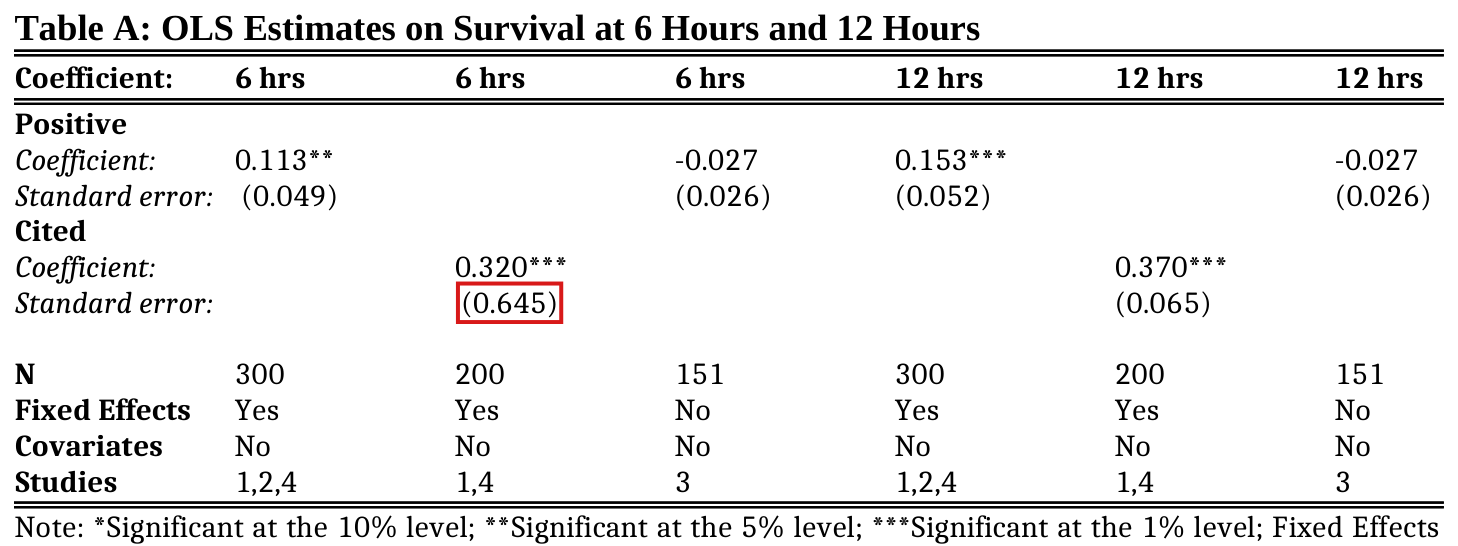
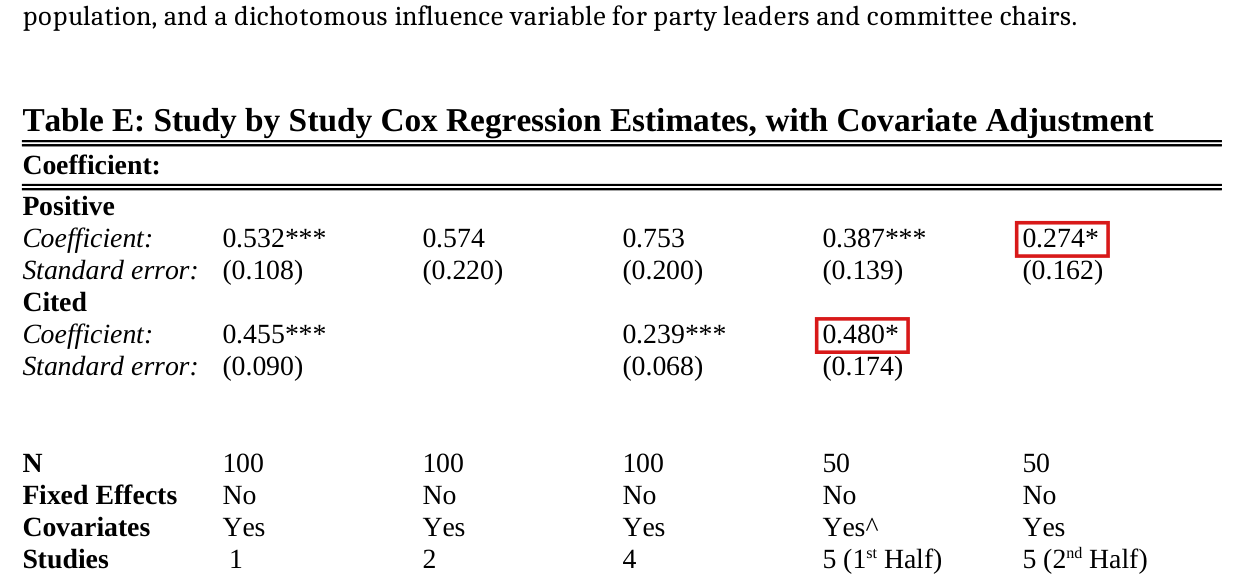
The data do contain evidence of a narrower kind. In the first days, the difference in survival between positive and negative facts was larger on the pages of sitting senators: 0.153 against at 12 hours and 0.127 against at 7 days, and a test rejects equality of these survival differences at both times. A smaller absolute difference does not show that relative bias is absent, because the same relative preference can produce a smaller absolute difference on pages that are edited less often. Further, the experiments randomized the valence of a fact and not the population of pages. The pages of sitting and of former senators differ in more than political activity. These comparisons therefore do not identify political activity as the cause of the bias, and they do not exclude Wikipedia’s culture or the enforcement of its policy on living persons as explanations. The second paragraph of the Discussion allows as much when it says that editors may apply the guidelines for living persons more conservatively to sitting senators.
Evidence an exact counterexample
The evidence is a recalculation from the replication files and an exact counterexample.
The recalculation reproduces the four printed hazard ratios and standard errors of S6 Tables A and C and the three -values of the main text. The figure shows the estimates with their 95% intervals. To compare the two populations, I fit a Cox model to Studies 1–4 with an interaction between valence and Study 3. The ratio between the hazard ratio for former senators and the hazard ratio for sitting senators is 1.12 (), or 1.09 () when the baseline hazard is stratified by study. Treating the samples as independent and approximating the log hazard ratio standard errors by and , the printed entries give
At 12 hours, the difference in survival between positive and negative facts is for sitting senators and for former senators, and the gap between the two populations has . At 7 days the corresponding figures are 0.127, and . When the comparison for sitting senators is restricted to cited facts, the differences are 0.140 and 0.138, with and .
The counterexample shows that such a gap in absolute differences is compatible with one and the same relative bias. Suppose that, in each population, positive facts are removed at the constant hazard per hour and negative facts at the constant hazard per hour, where for sitting senators and for former senators. Then in both populations. The probability that a fact survives 12 hours is for a positive fact and for a negative fact, which gives .
| Pages | |||||
|---|---|---|---|---|---|
| Sitting senators | |||||
| Former senators |
The model illustrates the logical point and is not a fit to the data.
What survives
The bias on the pages of sitting senators stands (hazard ratio 0.629, ). The statement that Study 3 detected no difference also stands, and so does the sentence of the abstract that reports “no evidence of an editorial bias” for former senators, read as a statement that none was detected. The early absolute differences in survival were smaller on the pages of former senators, also when the comparison is restricted to cited facts. The findings on citations do not depend on this interpretation. What is given up is the conclusion that the bias is limited to active politicians and is not systemic to Wikipedia, and the exclusion of Wikipedia’s culture and of its policy on living persons as explanations. No data and no estimate change.
Corrected
End of the section on Study 3, in place of the two sentences: “Study 3 detected no statistically clear difference between positive and negative facts over the full follow-up. Its estimate of the relative effect is imprecise and does not exclude the estimate for sitting senators. Early absolute differences in survival were smaller on the sampled pages of former senators, also when the comparison is restricted to cited facts. These comparisons do not establish that relative bias is absent on the pages of former senators, do not identify political activity as the cause of the bias, and do not exclude Wikipedia’s culture or the enforcement of its policy on biographies of living persons as explanations.”
Discussion, p. 5: “In a test conducted on the Wikipedia pages of recently retired and deceased senators, no editorial bias was detected; the estimate is too imprecise to show that this bias is limited to the pages of active politicians or that it is not systemic to Wikipedia.”


















My comment and the history of this entry