Assumptions and verification
Claim revision: source-claim-import-2026-11-08:P018-T2:1
Standing assumptions: The article is Aronow, Samii and Assenova, ‘Cluster–Robust Variance Estimation for Dyadic Data’, Political Analysis 23:564–577 (2015). Printed page = PDF page + 563 (printed p. 566 is PDF p. 3). Everything quoted below and in the targets was read from the rendered page images (staged/pages/p-NN.png, checked against 200–300 dpi renderings of staged/main.pdf). Primes are transposes. The paper writes $\epsilon_d$ for the population residual and $e_d$ for the fitted (sample) residual; the two are different objects throughout.
(S1) Sampling and dyads, p. 566 (PDF p. 3): “Begin with a large population from which we take a random (i.i.d.) sample of units, with the sample members indexed by $i = 1, ..., N$ and grouped into $D = \binom{N}{2} = N(N-1)/2$ dyads. Pairs of unit indices within each dyad map to dyadic indices, $1, ..., D$, through the index function $d(i,j) = d(j,i)$, with an inverse correspondence $s(d(i,j)) = \{i,j\}$, and we assume no $d(i,i)$ type dyads.”
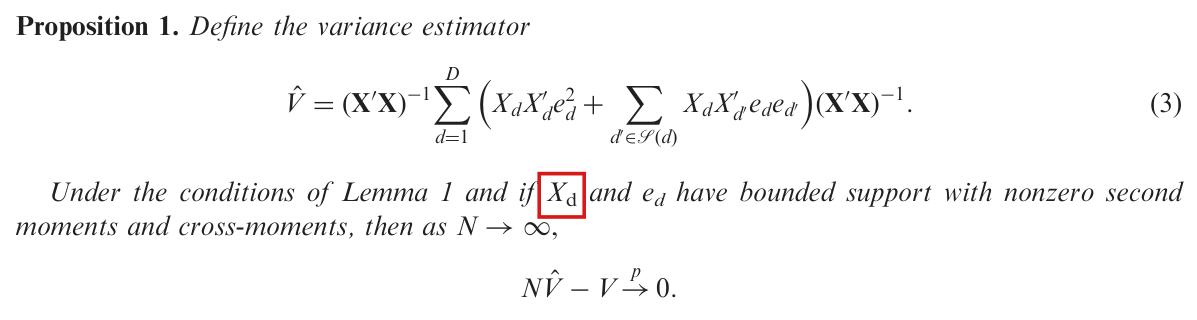
(S2) Regression and estimand, p. 566: “Consider a linear regression of $Y_{d(i,j)}$ on a $k$-length column vector of regressors $X_{d(i,j)}$ (which includes the constant): $$Y_{d(i,j)} = X'_{d(i,j)}\beta + \epsilon_{d(i,j)},$$ where $\beta$ is the slope that we would obtain if we could fit this model to the entire population, allowing for possible non-linearity in the true relationship between $\mathrm{E}[Y_{d(i,j)}|X_{d(i,j)}]$ and $X_{d(i,j)}$, and $\epsilon_{d(i,j)}$ is the corresponding population residual.$^3$ To lighten notation, for the remainder of the discussion we use $d = d(i,j)$.” Footnote 3, p. 566: “If $\mathrm{E}[Y_{d(i,j)}|X_{d(i,j)}]$ is non-linear in $X_{d(i,j)}$, the population residual will itself vary in $X_{d(i,j)}$, which undermines inference that assumes that $\epsilon_{d(i,j)}$ is independent of $X_{d(i,j)}$. The agnostic regression approach avoids such an assumption.”
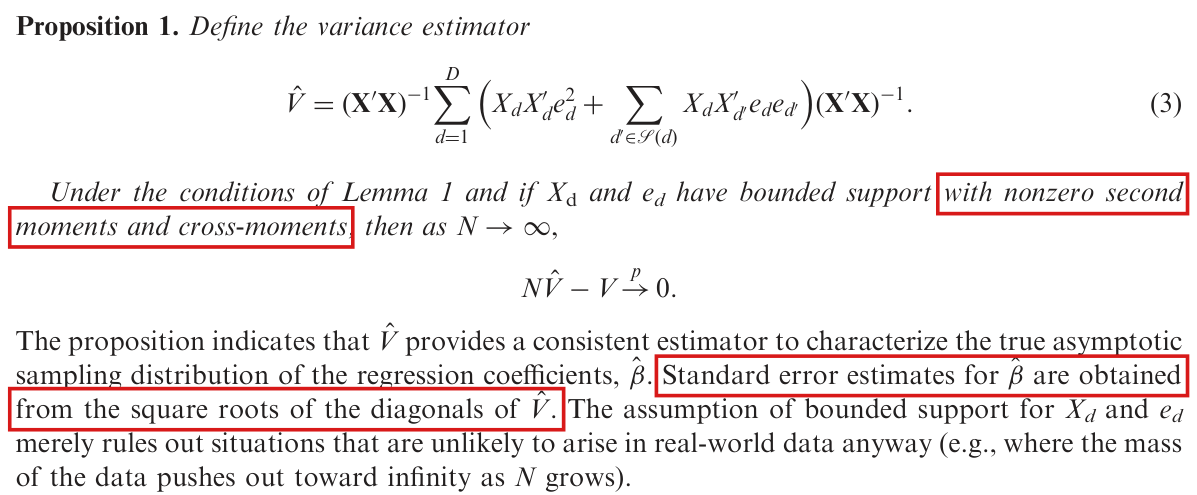
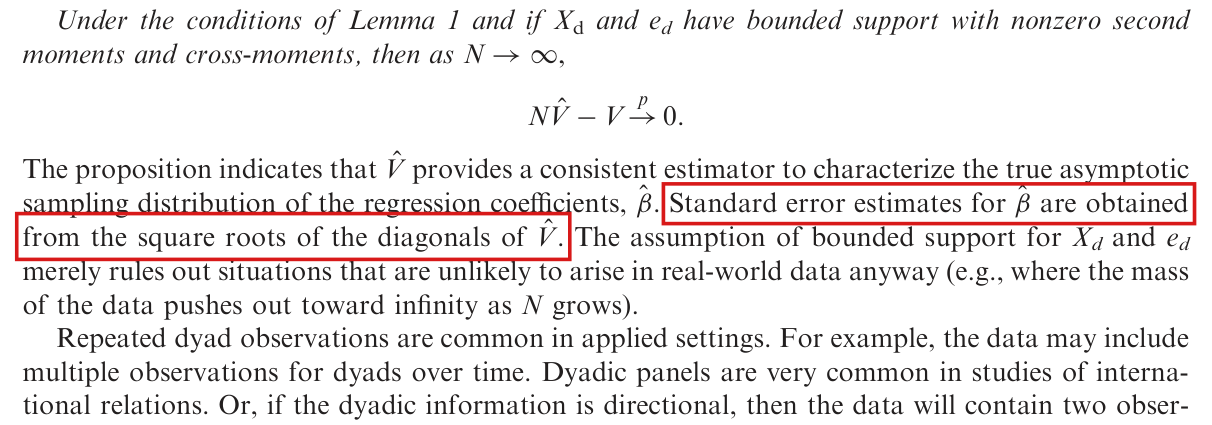
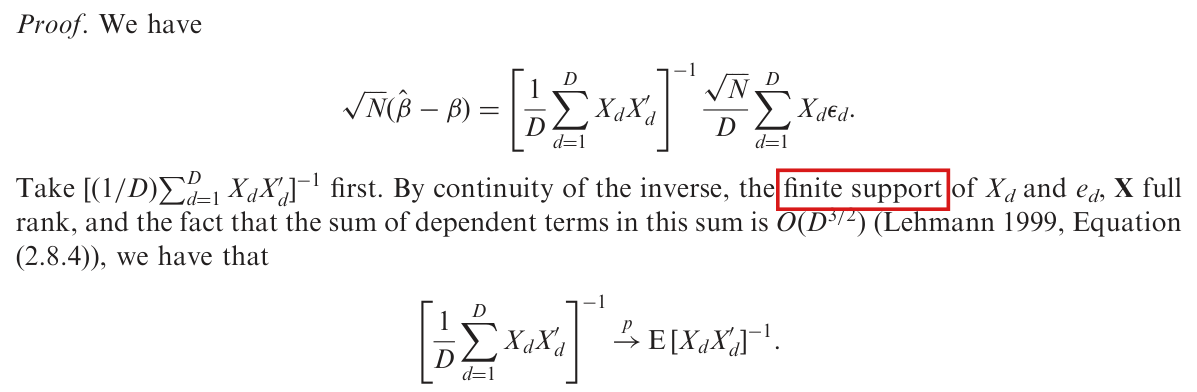
(S3) Estimator, p. 566: “Define the sample data as $\mathbf{X} = (X_1 ... X_D)'$ and $Y = (Y_1 ... Y_D)'$. The ordinary least squares (OLS) estimator is $$\hat\beta = (\mathbf{X}'\mathbf{X})^{-1}\mathbf{X}'Y,$$ with residual $e_d = Y_d - X'_d\hat\beta$.”
(S4) Dependence, boundedness and rank, p. 566: “Since the values of $Y_d$ and $X_d$ are determined by the characteristics of the units $i$ and $j$, $\epsilon_d$ and $\epsilon_{d'}$ for dyads containing either unit $i$ or $j$ are allowed to be correlated by construction. However, by random sampling of units, $\mathrm{Cov}(\epsilon_d, \epsilon_{d'}) = 0$ for all dyads that do not share a member. The number of pairwise dependencies between $i$ and $j$ for which $\mathrm{Cov}(\epsilon_d, \epsilon_{d'}) \ne 0$ is $O(N^3)$. Let the support for $X_d$ and $Y_d$ be bounded in a finite interval and assume the usual rank conditions on $\mathbf{X}$ (Chamberlain 1982; White 1984).”
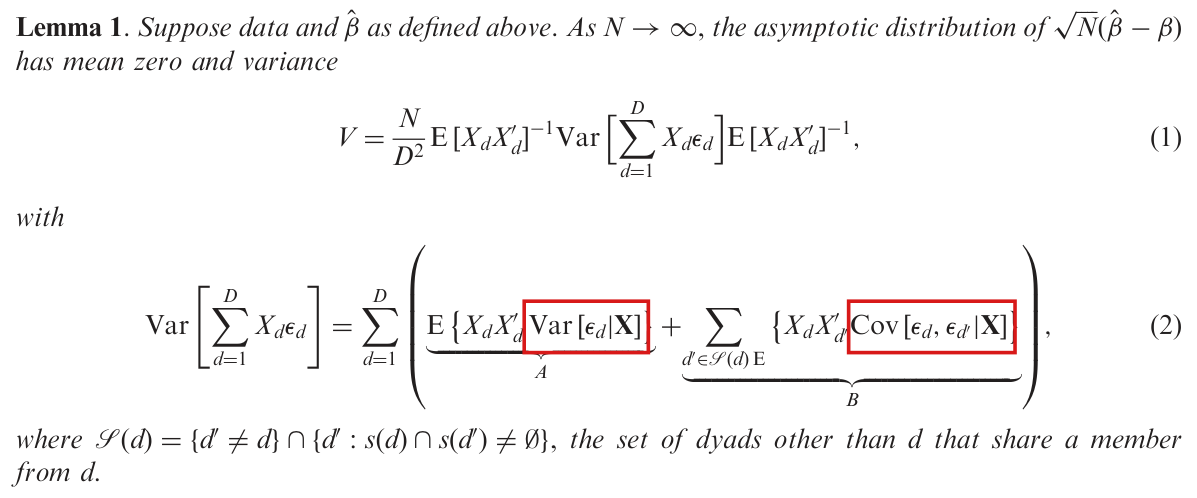
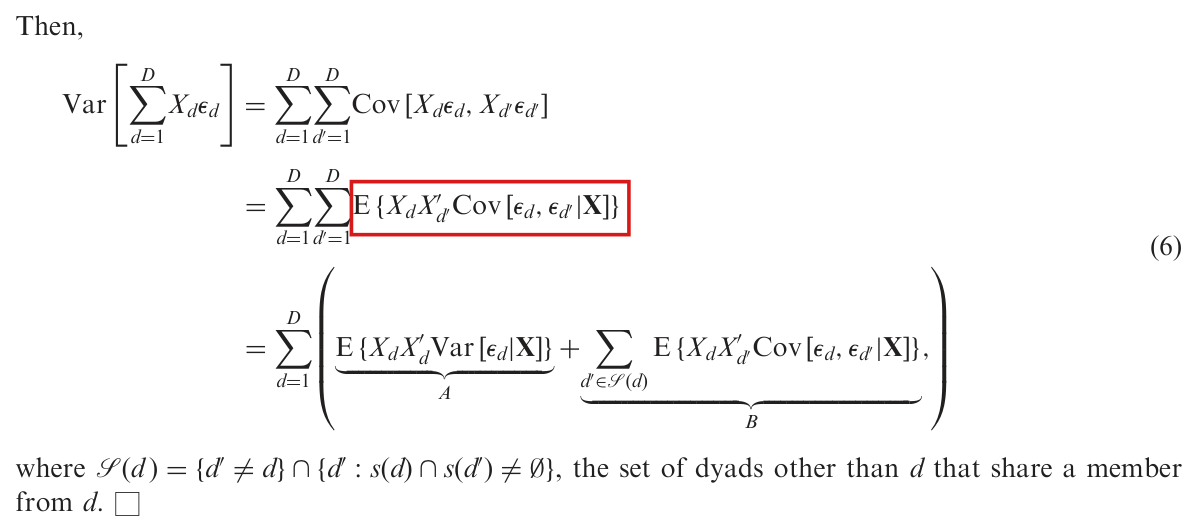
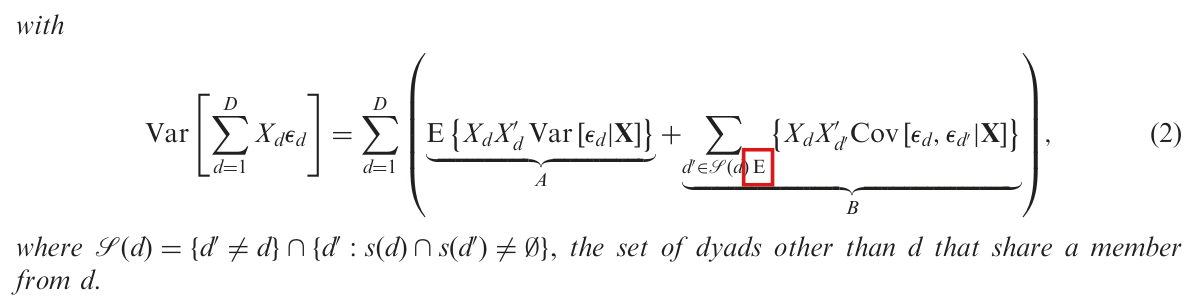
(S5) Neighbouring dyads, p. 566 (repeated on p. 573): “$\mathcal{S}(d) = \{d' \ne d\} \cap \{d' : s(d) \cap s(d') \ne \emptyset\}$, the set of dyads other than $d$ that share a member from $d$.”
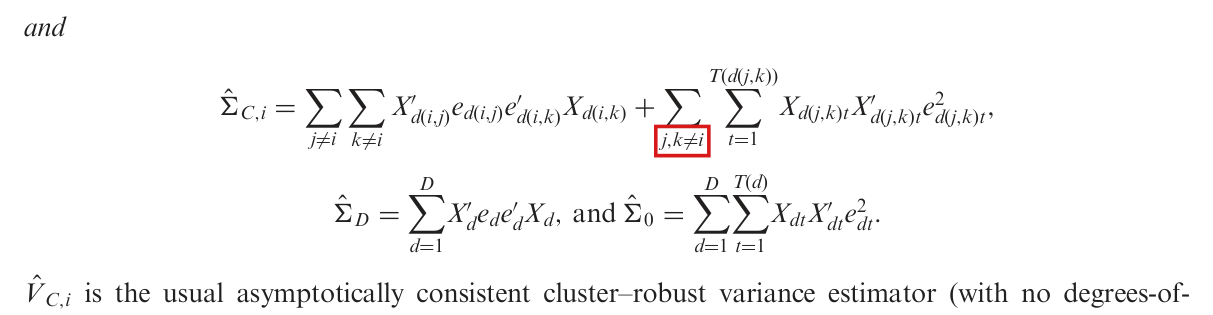
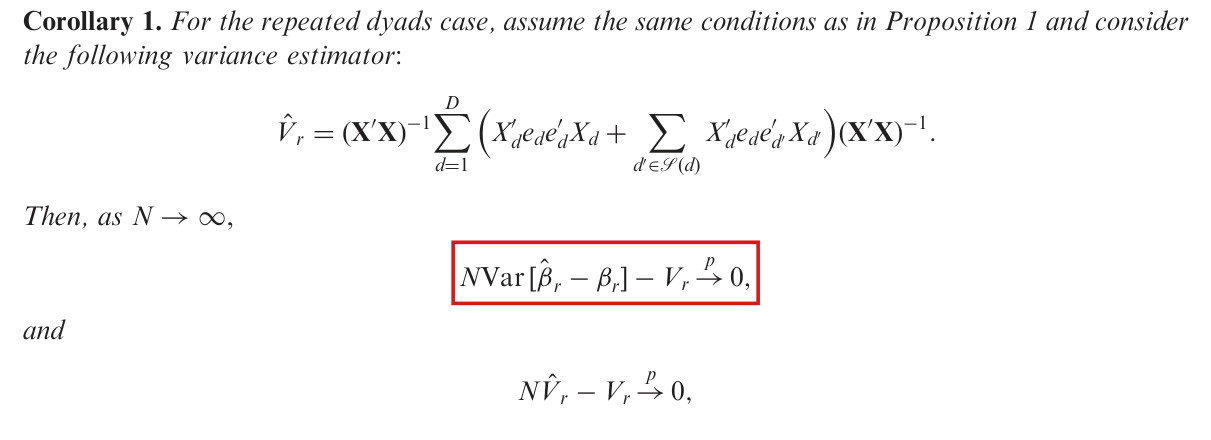
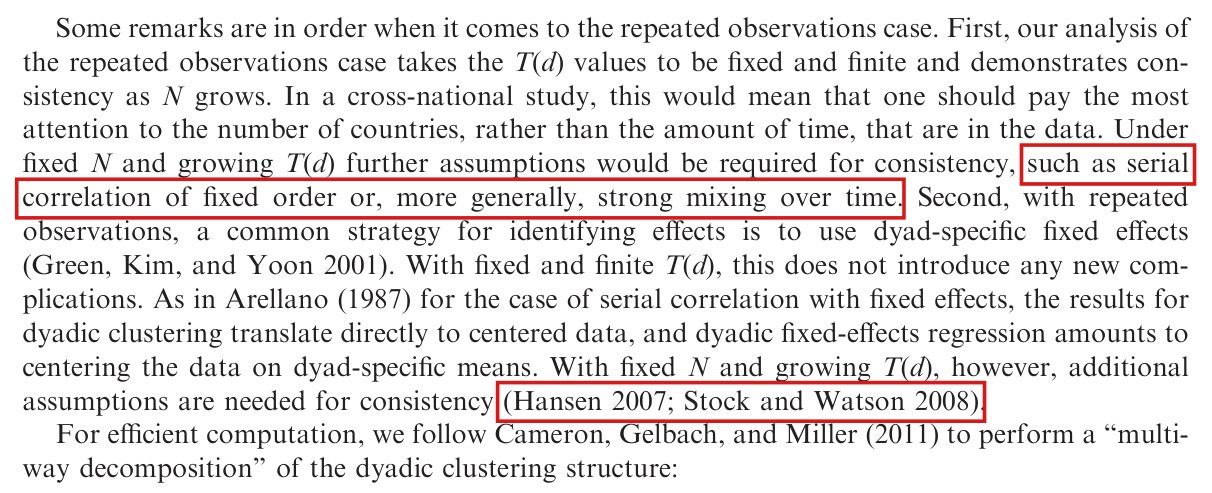
(S6) Repeated dyads, p. 567 (PDF p. 4): “Formally, suppose that for each dyad $d$ observations are indexed by $t = 1, ..., T(d)$, where the $T(d)$ values are fixed and finite. Let $(Y_{dt}, X'_{dt})$ represent the data for observation $t$ from dyad $d$, $$Y_d = \begin{pmatrix} Y_{d1} \\ \vdots \\ Y_{dT(d)} \end{pmatrix} \quad\text{and}\quad X_d = \begin{pmatrix} X'_{d1} \\ \vdots \\ X'_{dT(d)} \end{pmatrix},$$ and $Y = (Y'_1 \ldots Y'_d \ldots Y'_D)'$ and $\mathbf{X} = (X'_1 \ldots X'_d \ldots X'_D)'$, that is, the stacked $Y_d$ vectors and $X_d$ matrices, and let $\beta_r$ and $\hat\beta_r$ denote, respectively, the population slope and OLS estimator as defined above but now applied to the repeated dyads data.” In this case $X_d$ is a $T(d) \times k$ matrix and $e_d$, $\epsilon_d$ are $T(d)$-vectors.
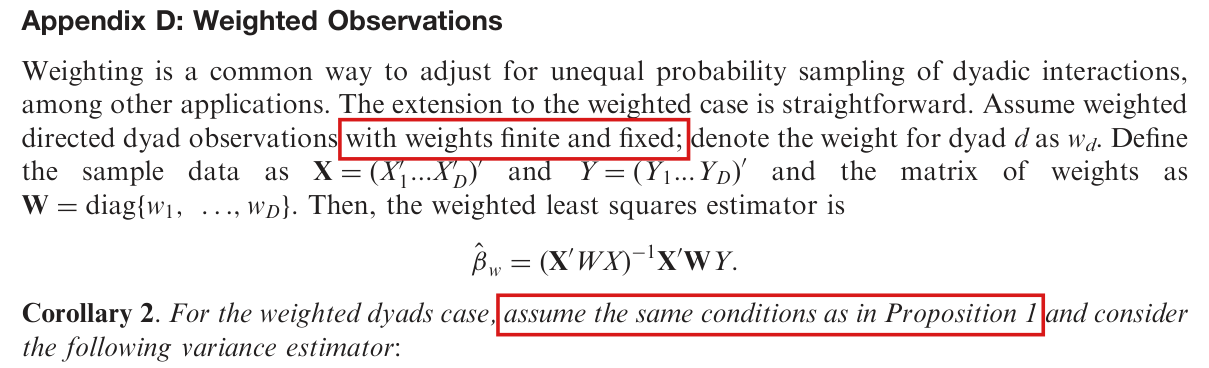
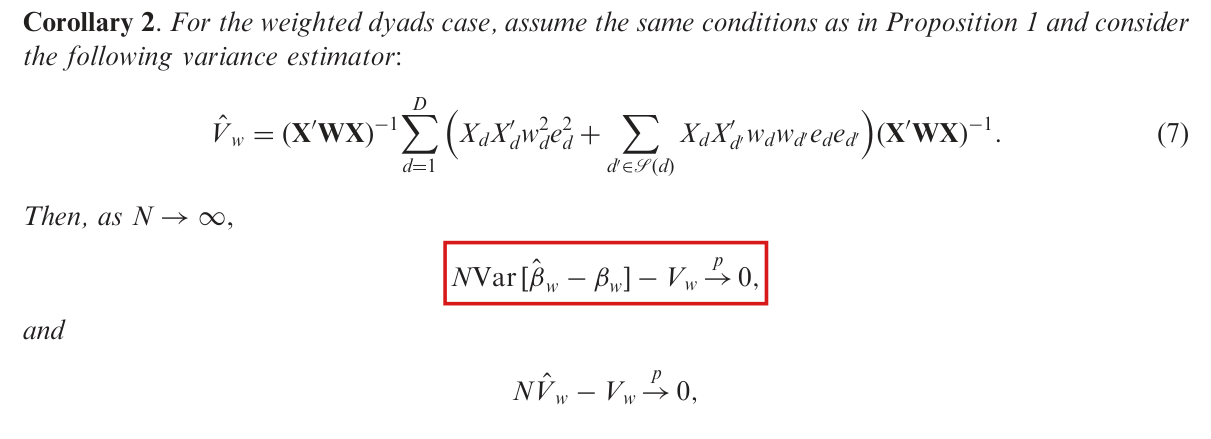
(S7) Weighted observations, Appendix D, p. 575 (PDF p. 12): “Assume weighted directed dyad observations with weights finite and fixed; denote the weight for dyad $d$ as $w_d$. Define the sample data as $\mathbf{X} = (X'_1 ... X'_D)'$ and $Y = (Y_1 ... Y_D)'$ and the matrix of weights as $\mathbf{W} = \mathrm{diag}\{w_1, \ldots, w_D\}$. Then, the weighted least squares estimator is $$\hat\beta_w = (\mathbf{X}'WX)^{-1}\mathbf{X}'\mathbf{W}Y.$$” (In the display the $W$ and $X$ inside the inverse are set in italic, not bold; the meaning is $(\mathbf{X}'\mathbf{W}\mathbf{X})^{-1}$.) The paper does not define $\beta_w$.
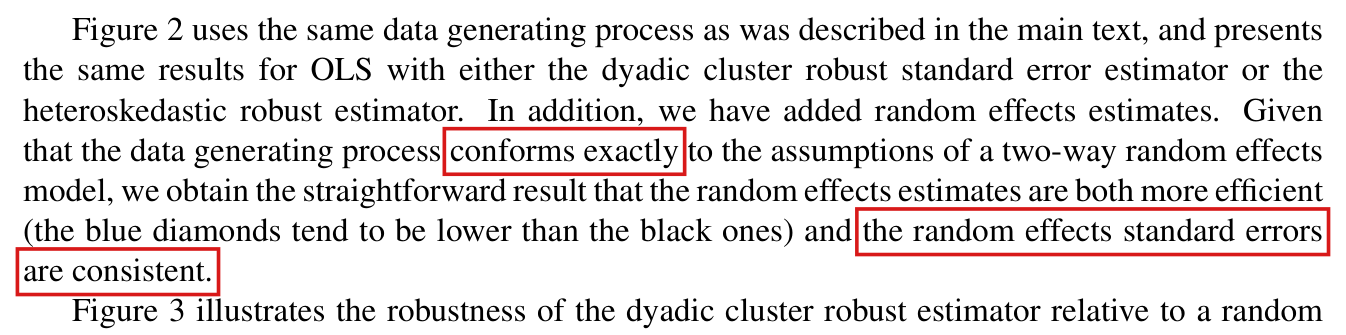
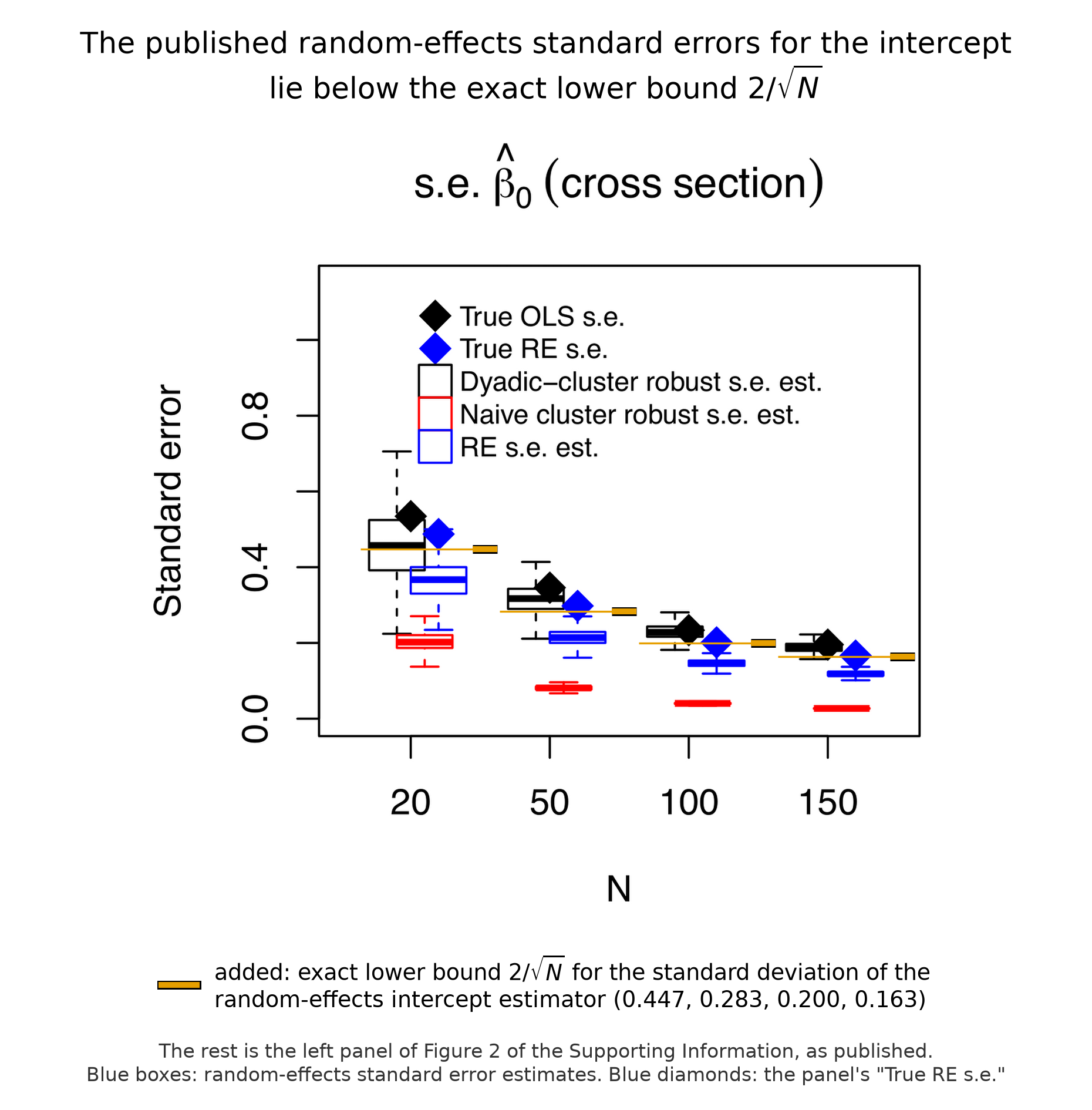
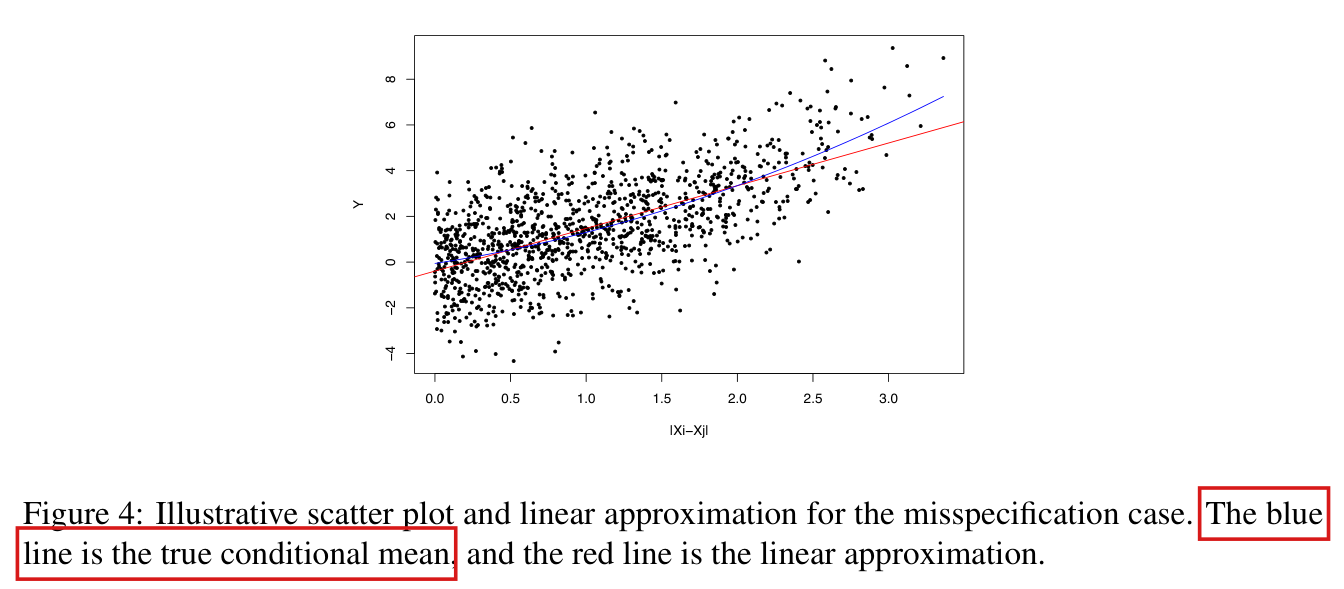
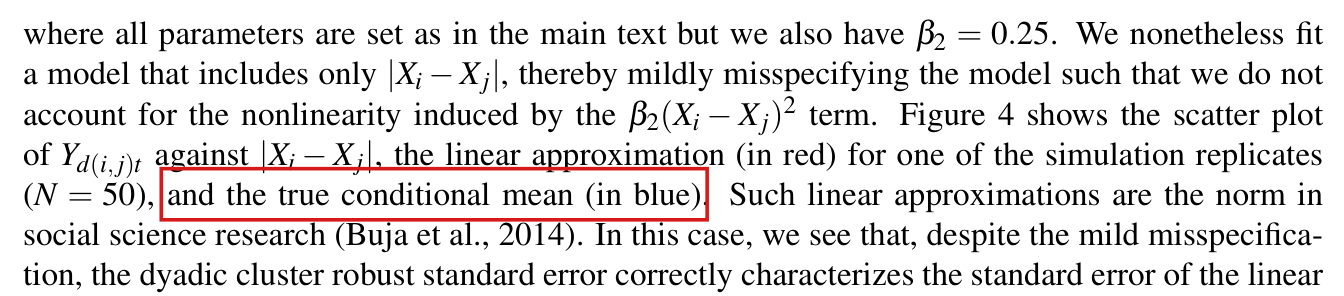
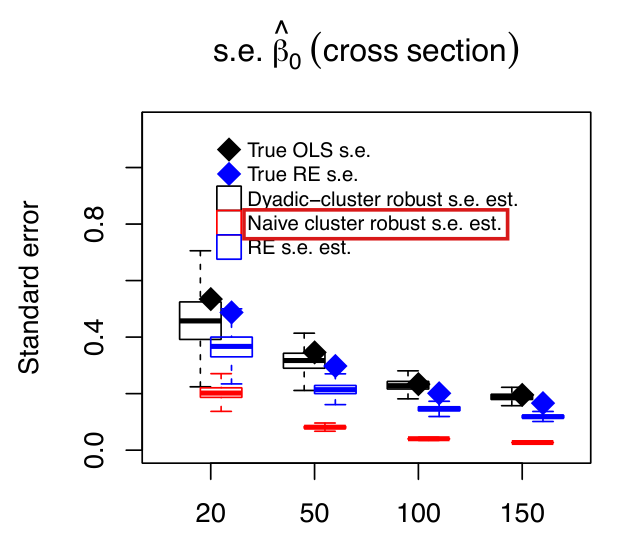
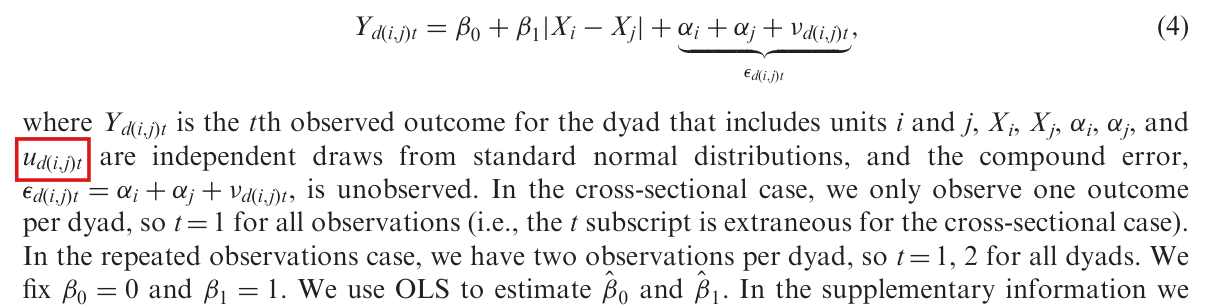
(S8) Simulation design, p. 569 (PDF p. 6): “We suppose that population values obey the following: $$Y_{d(i,j)t} = \beta_0 + \beta_1|X_i - X_j| + \underbrace{\alpha_i + \alpha_j + \nu_{d(i,j)t}}_{\epsilon_{d(i,j)t}}, \qquad (4)$$ where $Y_{d(i,j)t}$ is the $t$th observed outcome for the dyad that includes units $i$ and $j$, $X_i$, $X_j$, $\alpha_i$, $\alpha_j$, and $u_{d(i,j)t}$ are independent draws from standard normal distributions, and the compound error, $\epsilon_{d(i,j)t} = \alpha_i + \alpha_j + \nu_{d(i,j)t}$, is unobserved. In the cross-sectional case, we only observe one outcome per dyad, so $t = 1$ for all observations (i.e., the $t$ subscript is extraneous for the cross-sectional case). In the repeated observations case, we have two observations per dyad, so $t = 1, 2$ for all dyads. We fix $\beta_0 = 0$ and $\beta_1 = 1$. We use OLS to estimate $\hat\beta_0$ and $\hat\beta_1$.”
(S9) Reading used by the validators (the audit's formalization of S1–S4; not printed as such). Each unit carries a characteristic $U_i$, the $U_i$ are i.i.d., and $(X_{d(i,j)}, Y_{d(i,j)}) = f(U_i, U_j)$ for one symmetric measurable $f$, with $X_d \in \mathbb{R}^k$ and $Y_d \in \mathbb{R}$ bounded. Hence collections of dyads on disjoint sets of units are independent, and all dyads have the same marginal law. $Q = \mathrm{E}[X_dX'_d]$ is nonsingular (the ‘usual rank conditions’), $\beta = Q^{-1}\mathrm{E}[X_dY_d]$ is the population least-squares projection, $\epsilon_d = Y_d - X'_d\beta$, so that $\mathrm{E}[X_d\epsilon_d] = 0$; nothing makes $\mathrm{E}[\epsilon_d|\mathbf{X}] = 0$. The limit is $N \to \infty$. For repeated dyads the reading is $\beta_r = (\sum_d \mathrm{E}[X'_dX_d])^{-1}\sum_d \mathrm{E}[X'_dY_d]$ and $\epsilon_d = Y_d - X_d\beta_r$; for weights, $\beta_w = (\sum_d w_d\mathrm{E}[X_dX'_d])^{-1}\sum_d w_d\mathrm{E}[X_dY_d]$ and $\epsilon_d = Y_d - X'_d\beta_w$.
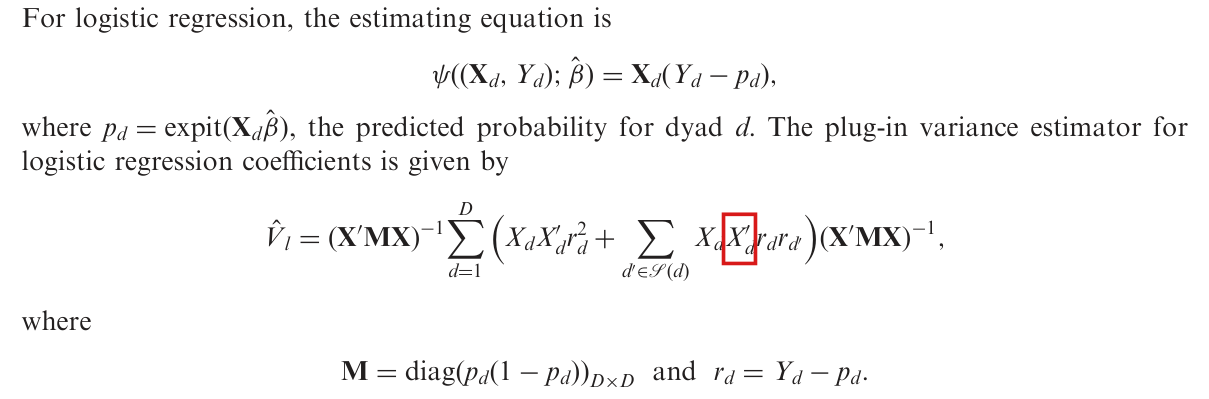
Scope of the list. Targets are the paper's formal results (Lemma 1, Propositions 1–2, Corollaries 1–2, the logistic estimator of Appendix E) and every confirmed error whose correction changes a mathematical statement, a formula or a proof step: P018-E001, E002, E003, E004, E005, E006, E007, N001, N003, N004, N006, N010. Two findings about the reported evidence rest on exact formal arguments and are targets for that formal content only: P018-E008 (the fitted random-effects benchmark has a covariance family that excludes the covariance of design (4)) and P018-E012 (‘an order of magnitude’ against the ratios of Table 1; the validator's evidence is itself a Lean proof). Not targets: P018-E009 (a mislabelled curve in SI Figure 4), E010 (sample counts), E011 (description of a regressor), E014 and E015 (wording and reference-list misprints), N008 (a cross-reference), which are findings about figures, data, reporting and bibliography with no mathematical statement to correct; P018-E013 and N002 (clarity notes); P018-N005 and N009 (not confirmed); P018-N007, N011, N012, N013 (out of scope). Of the headline claims, P018-H1 (Lemma 1, Proposition 1), H3 (Corollaries 1–2), H4 (Appendix E) and H5 (Proposition 2) are mathematical statements and are covered by P018-T26–T29, T14 and T16; H2 is the interpretive claim of valid inference under misspecification, whose formal content is T2, T4 and T8; H6–H10 are simulation and empirical claims.
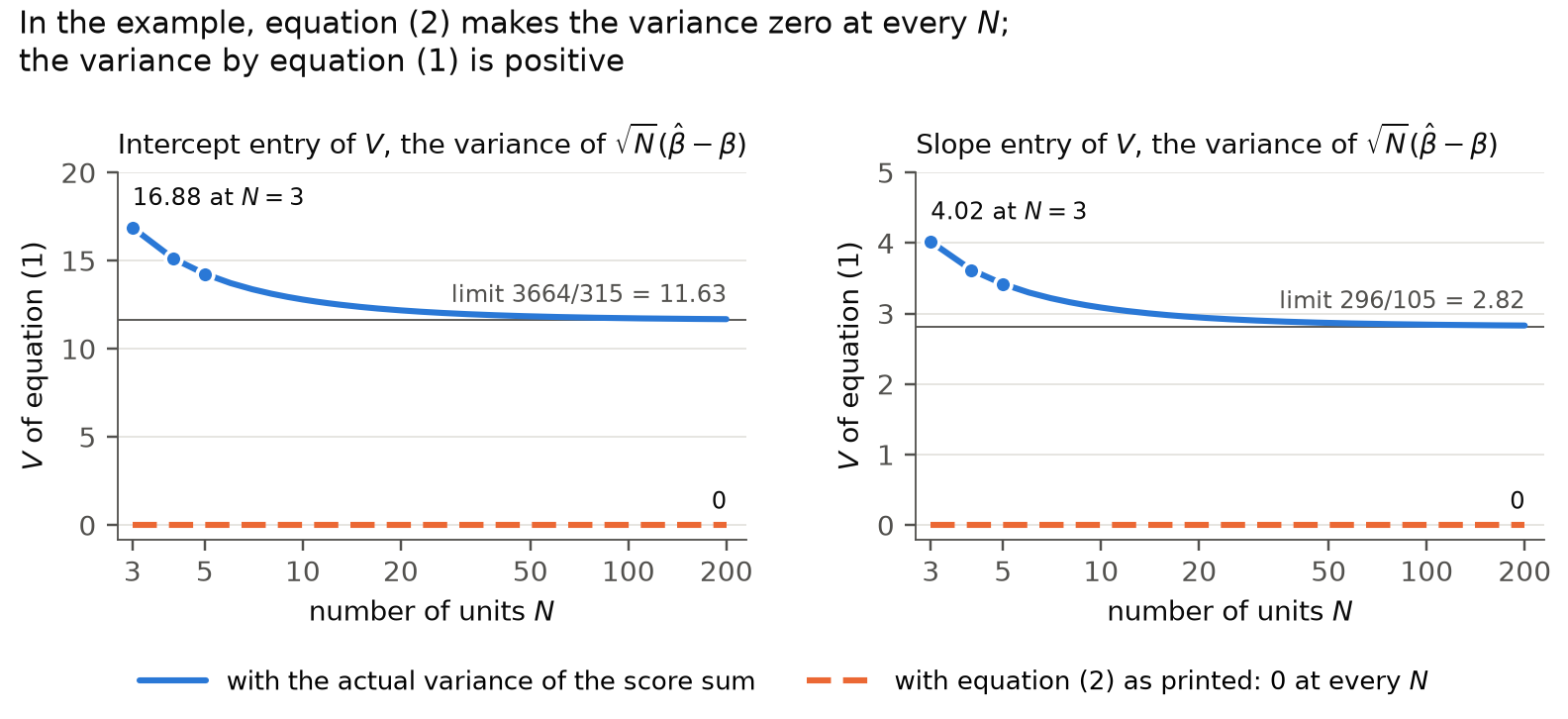
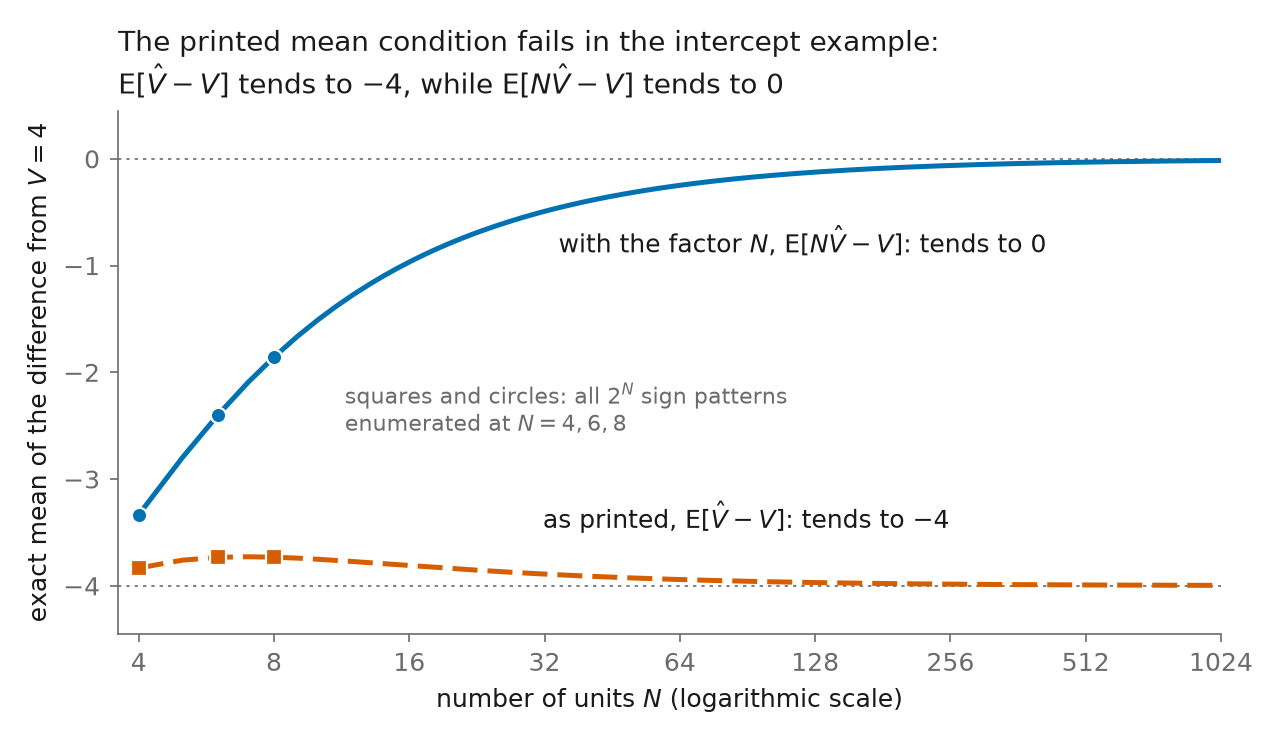
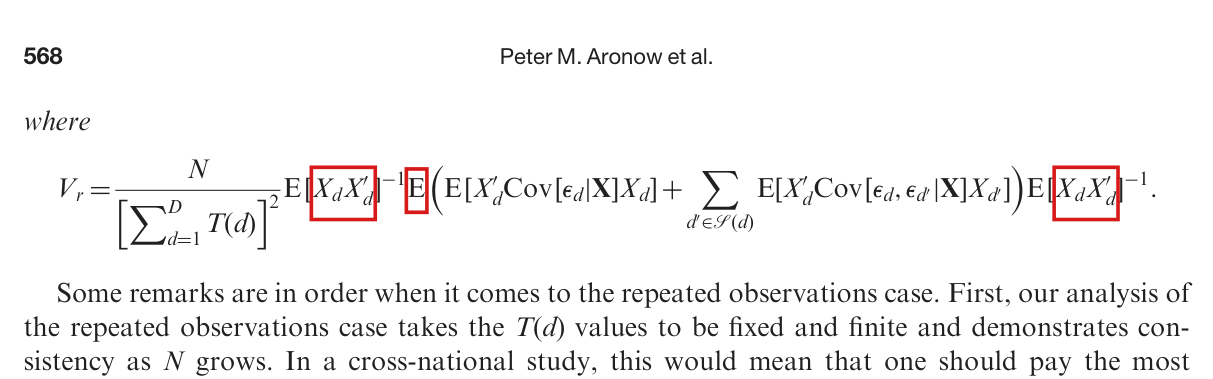
Effective claim (source TeX): Smallest repair for P018-E001, with the repeated/weighted prescription made explicit: “For the single-record model below, replace the conditional variance/covariance meat in (2), (6), and Appendix B by \Sigma_N^*=\sum_d(\mathrm E[X_dX_d'\epsilon_d^2]+\sum_{d'\in\mathcal S(d)}\mathrm E[X_dX_{d'}'\epsilon_d\epsilon_{d'}]), which equals Var(sum_d X_d epsilon_d) under the stated projection orthogonality and disjoint-dyad independence. In $V_r$ and $V_w$, use the unconditional covariance of the total score, $\Omega_a=\operatorname{Var}(\sum_d h_d^a)$, for $a\in\{r,w\}$, with $h_d^r=X_d'\epsilon_d^r$ and, for one weighted record per dyad, $h_d^w=w_dX_d\epsilon_d^w$. For disjoint-dyad independent block scores, this is the sparse sum of unconditional score covariances. Uncentered score cross-moments may replace those covariances if every block score has mean zero; global projection orthogonality alone does not supply that condition. Alternatively add Var(E[sum_d X_d epsilon_d | bold X]) to the full conditional double sum, retaining any disjoint conditional terms unless their vanishing is justified. Update the associated expectation-identification argument with the proper normalization. Move the misplaced E in (2) in front of its braces.”
Corrected statement, with every hypothesis. Assume (S9): i.i.d. unit characteristics $U_1,\ldots,U_N$ ($N \ge 2$); $(X_{d(i,j)}, Y_{d(i,j)}) = f(U_i,U_j)$ with $f$ symmetric, $X_d \in \mathbb{R}^k$ and $Y_d$ bounded; $Q = \mathrm{E}[X_dX'_d]$ nonsingular; $\beta = Q^{-1}\mathrm{E}[X_dY_d]$; $\epsilon_d = Y_d - X'_d\beta$. Put $h_d = X_d\epsilon_d$, $S = \sum_{d=1}^{D} h_d$ and $m_d = \mathrm{E}[\epsilon_d|\mathbf{X}]$. Then:
(i) $\mathrm{E}[h_d] = 0$ for every $d$, and $\mathrm{E}[h_dh'_{d'}] = 0$ whenever $s(d)\cap s(d') = \emptyset$.
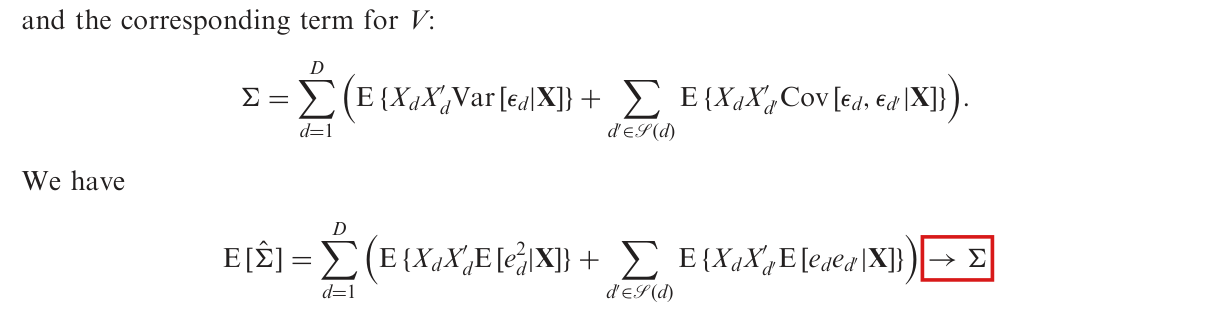
(ii) [Equation (2), corrected] $$\mathrm{Var}\Big[\sum_{d=1}^{D}X_d\epsilon_d\Big] = \sum_{d=1}^{D}\Bigg(\mathrm{E}\big[X_dX'_d\epsilon_d^2\big] + \sum_{d'\in\mathcal{S}(d)}\mathrm{E}\big[X_dX'_{d'}\epsilon_d\epsilon_{d'}\big]\Bigg) =: \Sigma_N^* .$$ Equivalently, in the printed form with $\mathrm{Var}[\epsilon_d|\mathbf{X}]$ replaced by $\mathrm{E}[\epsilon_d^2|\mathbf{X}]$ and $\mathrm{Cov}[\epsilon_d,\epsilon_{d'}|\mathbf{X}]$ by $\mathrm{E}[\epsilon_d\epsilon_{d'}|\mathbf{X}]$: $\Sigma_N^* = \sum_{d}\big(\mathrm{E}\{X_dX'_d\mathrm{E}[\epsilon_d^2|\mathbf{X}]\} + \sum_{d'\in\mathcal{S}(d)}\mathrm{E}\{X_dX'_{d'}\mathrm{E}[\epsilon_d\epsilon_{d'}|\mathbf{X}]\}\big)$.
(iii) [What the second line of (6) omits] $$\mathrm{Var}(S) = \sum_{d=1}^{D}\sum_{d'=1}^{D}\mathrm{E}\{X_dX'_{d'}\mathrm{Cov}[\epsilon_d,\epsilon_{d'}|\mathbf{X}]\} + M_N, \qquad M_N = \mathrm{Var}\big(\mathrm{E}[S|\mathbf{X}]\big) = \mathrm{Var}\Big(\sum_{d=1}^{D}X_dm_d\Big),$$ the first sum being $\mathrm{E}[\mathrm{Var}(S|\mathbf{X})]$. $M_N$ is positive semidefinite. The second equality of (6) holds if and only if $M_N = 0$; $m_d = 0$ almost surely for all $d$ is sufficient for $M_N = 0$, and $\mathrm{E}[X_d\epsilon_d] = 0$ alone is not (P018-T1).
(iv) [The sparse form of (2)] If $P_N$ denotes the right-hand side of (2) with the expectation of term $B$ placed before the braces as in (6), then $$\mathrm{Var}(S) - P_N = M_N + \sum_{(d,d'):\, s(d)\cap s(d') = \emptyset}\mathrm{E}\{X_dX'_{d'}\mathrm{Cov}[\epsilon_d,\epsilon_{d'}|\mathbf{X}]\} .$$
(v) [Closed form] With $H = \mathrm{E}[h_{d(1,2)}h'_{d(1,2)}]$, define $g(u)=\int h(u,v)\,\mu(dv)$ and $\Gamma=\mathrm{E}[g(U_1)g(U_1)']$ for every $N\ge2$, using the population score kernel $h(u,v)$ and unit law $\mu$. For $N\ge3$, also $\Gamma=\mathrm{E}[h_{d(1,2)}h'_{d(1,3)}]$. Thus $\Gamma$ is symmetric positive semidefinite, and $$\Sigma_N^* = DH + N(N-1)(N-2)\Gamma, \qquad V = \frac{N}{D^2}Q^{-1}\Sigma_N^*Q^{-1} = Q^{-1}\Big(\frac{2}{N-1}H + \frac{4(N-2)}{N-1}\Gamma\Big)Q^{-1} \longrightarrow 4Q^{-1}\Gamma Q^{-1} .$$ Equation (1) is unchanged; its $\mathrm{Var}[\sum_d X_d\epsilon_d]$ is $\Sigma_N^*$.
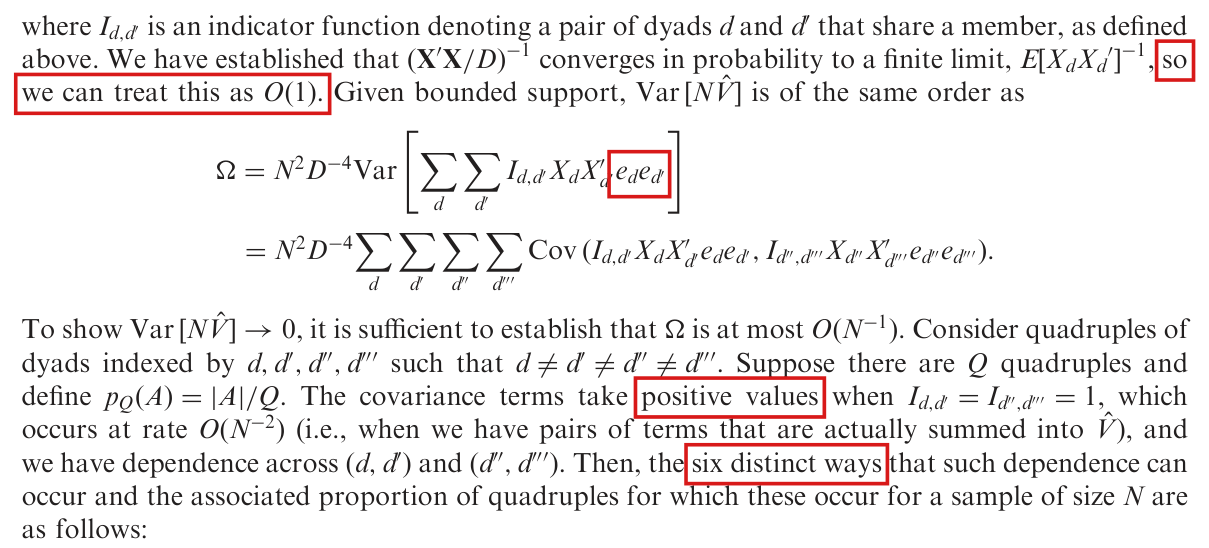
Repeated and weighted scores, with every hypothesis for this prescription. Fix an integer $N\ge2$ and $k\ge1$, and let the units $U_1,\ldots,U_N$ be i.i.d. For every unordered dyad $d=\{i,j\}$ let $T(d)\in\{1,2,\ldots\}$ be deterministic and finite. Each record $x_{dt}\in\mathbb R^k$, $Y_{dt}\in\mathbb R$, $1\le t\le T(d)$, is a bounded measurable function only of $(U_i,U_j)$; the record functions and counts may vary with $d$ and $t$. Let $X_d\in\mathbb R^{T(d)\times k}$ have rows $x_{dt}'$, and let $Y_d\in\mathbb R^{T(d)}$ be the response block. For fixed real weights $w_{dt}$ put $W_d=\operatorname{diag}(w_{d1},\ldots,w_{dT(d)})$ (one weighted observation is $T(d)=1$ and $w_{d1}=w_d$). Put $A_r=\sum_d\mathrm E[X_d'X_d]$, $b_r=\sum_d\mathrm E[X_d'Y_d]$, $A_w=\sum_d\mathrm E[X_d'W_dX_d]$, and $b_w=\sum_d\mathrm E[X_d'W_dY_d]$; assume the relevant $A_a$ is nonsingular, and define $\beta_a=A_a^{-1}b_a$ for $a\in\{r,w\}$. Use $\epsilon_d^a=Y_d-X_d\beta_a$, $h_d^r=X_d'\epsilon_d^r$, $h_d^w=X_d'W_d\epsilon_d^w$, $S_a=\sum_dh_d^a$, and $\mu_d^a=\mathrm E[h_d^a]$. These bounded, finite-record scores are square-integrable; scores on disjoint dyads are independent. For either $a\in\{r,w\}$ the expected normal equations give $\mathrm E[S_a]=0$, and the exact identity is
$$\Omega_a:=\operatorname{Var}(S_a)=\sum_{d=1}^D\sum_{f=1}^D\mathrm E[h_d^a(h_f^a)']=\sum_{\substack{d,f:\ s(d)\cap s(f)\ne\varnothing}}\operatorname{Cov}(h_d^a,h_f^a)=\sum_{\substack{d,f:\ s(d)\cap s(f)\ne\varnothing}}\left(\mathrm E[h_d^a(h_f^a)']-\mu_d^a(\mu_f^a)'\right).$$
All these sums are over ordered pairs, including $d=f$. In particular,
$$\sum_{\substack{d,f:\ s(d)\cap s(f)\ne\varnothing}}\mathrm E[h_d^a(h_f^a)']=\Omega_a+\sum_{\substack{d,f:\ s(d)\cap s(f)\ne\varnothing}}\mu_d^a(\mu_f^a)'.$$
Consequently the sparse raw-moment sum equals $\Omega_a$ exactly when the displayed sum of products of block means is zero; $\mu_d^a=0$ for every $d$ is sufficient, while $\sum_d\mu_d^a=0$ alone is not. Without this cancellation, retain the centering products in the sparse sum, or retain all ordered pairs in the full raw-moment sum. With $L=\sum_dT(d)>0$, $H_r=A_r/L$, and $H_w=A_w/D$, the corresponding finite-$N$ covariance targets are $V_r=(N/L^2)H_r^{-1}\Omega_rH_r^{-1}$ and $V_w=(N/D^2)H_w^{-1}\Omega_wH_w^{-1}$, as in P018-T12. These are covariance identities; they do not by themselves assert consistency of a fitted-residual estimator.
: SAP.P018a.T2WholeStatement_W3
Theorem: SAP.P018a.T2
Statement hash: 9b00a426f26687d6ef0ef1ea09dd25b45f09131c969896c20bc63f2c8d3ece61
Statement definition: SAP.P018a.T2WholeStatement_W3
Certificate. 20261104T193651Z
Declaration review: faithful; 2026-11-04T20:05:27Z; binding v2
Evidence scope: Certification checks formal proof objects. Statement fidelity is a model judgment. Author review is separate.
Proof dependencies: Independently extracted
Manifest annotation reconciliation: Effective use follows the source-bound dependency observation; original annotations are retained in the crosswalk.
AronowAudit.P018.variance_sparse_identity: observed used
Source and evidence metadata · sap-2026-11-08-assured-release



















My comment and the history of this entry